Sweat Sensors and AI: A Practical Path to Real-Time Health Monitoring
Scientists are finding that sweat chemistry carries far more useful health data than most people expect. With better sensors and smarter algorithms, this humble fluid could help track health in real time and flag risks earlier than standard checks.
A new study in the Journal of Pharmaceutical Analysis lays out how sweat-based monitoring, paired with AI, could follow hormones and other biomarkers, track medication levels, and screen for early signals linked to diabetes, cancer, Parkinson's, and Alzheimer's. The approach isn't science fiction-it's built on advances already moving from labs into wearables.
Why sweat is worth watching
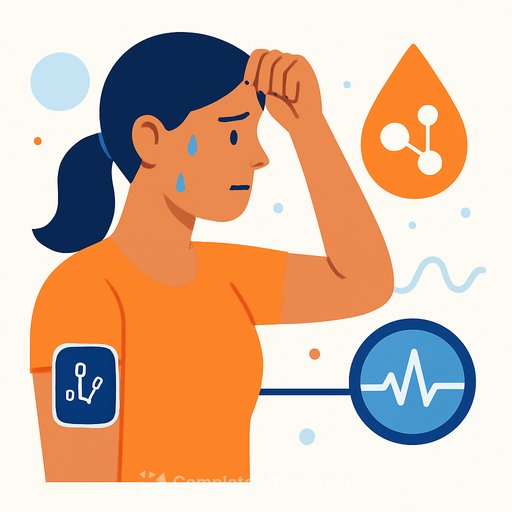
Sweat collection is painless, simple, and non-invasive. For anyone already using wearables for heart rate or activity tracking, sweat adds a richer layer: chemistry, not just motion or pulse.
There are consumer products today, like single-use patches that estimate sweat rate and sodium loss, offering personalized guidance for training and recovery. The next wave aims to go beyond hydration to meaningful clinical signals.
What the study shows
Researchers report that AI combined with microfluidic, skin-friendly patches can read subtle molecular patterns in sweat and link them to physiological states. That makes continuous tracking of biomarkers-such as glucose, cortisol, and electrolytes-more feasible outside the clinic.
According to the authors, potential applications include medication adherence monitoring, stress and hormone profiling, early detection of metabolic disorders, and even support for neurological screening. You can read the paper via its DOI: 10.1016/j.jpha.2025.101473.
AI-enabled diagnostics
When paired with lightweight sensors, AI can recognize patterns across multiple metabolites at once. That could give people timely insights and help clinicians interpret continuous data streams without adding workload.
For athletes, this points to live electrolyte tracking and potential pre-competition checks. For people with diabetes, future patches may offer sweat-based glucose monitoring to reduce finger pricks.
"Sweat is an underused diagnostic fluid," said Dr. Janice McCauley from the UTS Faculty of Science. "The ability to measure multiple biomarkers simultaneously, and transmit that data wirelessly, provides enormous potential for preventive health care. The year 2023 was marked by an evolutionary step in artificial intelligence, opening the door for improved pattern analysis and classification algorithms to improve diagnostic precision and therapeutic accuracy."
Advances in sensor design
Progress in microfluidics, flexible electronics, and low-power wireless has enabled skin-adhering patches that collect sweat continuously. These devices can pull tiny volumes, route them through microchannels, and analyze chemistry on the spot.
UTS teams are mapping baseline sweat physiology and building microfluidic systems sensitive enough to detect trace biomarkers like glucose and cortisol. "We're not far from a future where your wearable can tell you when you've got high stress hormone levels, and by monitoring this over time, whether you are at risk of chronic health conditions," said co-author Dr. Dayanne Bordin.
Who benefits and how
- Clinicians and care teams: Track medication adherence, dehydration risk, and stress trends between visits; support remote monitoring and early intervention.
- Researchers: Access high-frequency biochemical data for longitudinal studies; validate biomarkers against gold-standard blood tests; test new algorithms on real-world signals.
- Athletes and coaches: Quantify electrolyte loss, adjust hydration and recovery, and explore objective markers of training load.
- General public: Get alerts on heat risk, stress fluctuations, and wellness trends without needles or lab visits.
What still needs work
- Calibration and variability: Sweat rate, skin type, and environment affect readings. Devices need reliable normalization.
- Clinical validation: Large, diverse trials must confirm accuracy versus standard-of-care tests.
- Data security and consent: Continuous chemistry data is sensitive. Encryption, local processing, and clear consent flows are essential.
- Interoperability: Clean APIs and standardized formats help integrate with EHRs and research platforms.
- Cost and access: Keeping patches affordable and comfortable will determine adoption beyond elite athletes.
How to prepare your team
- Set criteria for sensor accuracy, calibration, and clinical endpoints before piloting devices.
- Plan a data pipeline: local preprocessing, secure transmission, and clinician-friendly dashboards.
- Start with focused use cases (e.g., hydration in cardiac rehab, stress markers in shift workers) and scale based on outcomes.
- Build AI literacy across clinical, research, and operations teams to interpret biosensor data responsibly.
If you're building skills to work with biosensor data and pattern analysis, explore practical AI courses here: Complete AI Training - Latest AI Courses.
Your membership also unlocks: