
AI news ·
Sydney emerging artist showcase faces backlash over AI-generated music act
An AI-generated music act sparked backlash after appearing at a Newtown showcase for emerging artists. The venue has since changed its booking process and donated bar profits to Support Act.
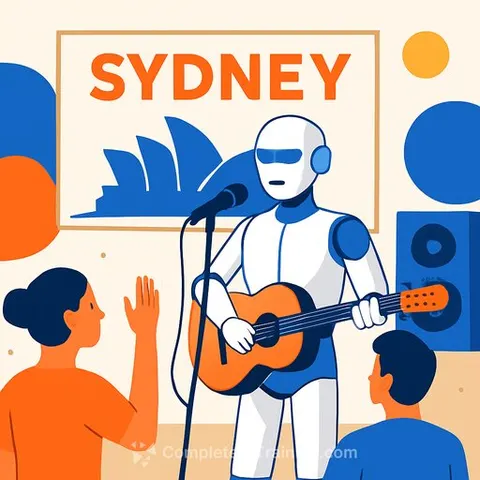
A showcase for emerging artists at Bootleggers in Kelly's on King in Newtown on Wednesday included an act that used AI-generated music, sparking immediate backlash from other performers on the bill. The incident exposes a growing tension in live music as AI tools, trained on vast catalogues of human work, begin to occupy slots that working musicians say should go to people.
Shock and disgust from a fellow performer
Aidan Sammut was at rehearsal with his bandmates preparing for the Mixed Bag event when they learned Afro Charles, one of the acts on the line-up, used AI-generated content. "Shock and then the shock kind of turned into disgust, I guess. Just sort of being offended at the fact that this could actually happen," Sammut said. He called the inclusion an insult, arguing the spot "could have been given to a human band" at an event designed for smaller acts trying to build a live following.
The AI act and its creator
Damian Amamoo, the human behind Afro Charles, uses the AI music generator Suno to create vocals for two virtual avatars-Mei Ling and Afro Charles-while he handles the live vocal performance. "There is a post there saying … we're a band of three, made up of two avatars or robots and a human being," Amamoo said, pointing to a disclosure on the act's Instagram page. He compares AI to drum machines or synthesisers. "This latest new wave of artificial intelligence technology is just the latest change to making music - and it won't be the last."
Suno lets users condition their own voice or use built-in singers. The platform has been sued by major record labels and most recently by production music library Jamendo over the training data that powers it, according to Billboard. Warner Music settled its own 2024 suit and signed a licensing deal with Suno late last year.
Artists push back on AI in music
Sammut rejected the comparison to sampling or electronic instruments. "It's fundamentally based on this theft of human art," he said. "I think it has a long way to go and a lot of things to address before it should be an accepted part of music-making." A dataset search tool created by The Atlantic recently showed millions of creative works, including songs by Australian artists Kylie Minogue, Jimmy Barnes, and Paul Dempsey, have been used to train AI. Dempsey was part of a group of Australian creatives who visited federal parliament this week to campaign against the uncompensated use of their work.
For Sammut, live performance income makes the stakes personal. "To program a good drum machine pattern or whatever, you still need to understand fundamentally what it takes to create a good rhythm," he said. AI, he argues, shortcuts the human skill at the core of the craft.
Venue and booking fallout
Good Intent, the music services company that booked the night, said it hadn't screened Amamoo's social media and released a statement: "Good Intent and Bootleggers have never knowingly and will never book people who use AI to generate music." Rory Summers, licensee of Kelly's on King, said the venue was told Afro Charles was a producer with live vocals-"To me that can mean a lot of things, someone on stage with a synth"-and that the venue doesn't aim to be an arbiter of taste.
Bootleggers donated the night's bar profits to Support Act, a charity for music industry workers, and has since changed its booking process to explicitly ask artists whether they use AI. Sammut remains "nervous" that AI performers will be pushed as a cheap alternative to paying human musicians. "It really is quite disheartening to see this become more … pushed on the music industry as sort of a cheap alternative to actually paying people," he said.
Why this matters for Creatives
AI-generated music has moved from a novelty to a live booking dispute, and the pressure on paid performance slots is real. Venues are starting to screen for AI use, but disclosure still depends largely on an artist's honesty. As musicians and venues grapple with this shift, resources like an AI Learning Path for Vocal Artists & Songwriters can help professionals understand the tools and their legal and creative implications. The fight isn't only about technology-it's about who gets paid to create and perform.