
AI news ·
Teachers use AI chatbots to support bilingual learners while weighing equity and accuracy concerns
K-12 teachers use AI chatbots to translate materials and tutor emergent bilingual students. Experts warn speech recognition flaws and unequal device access could widen gaps.
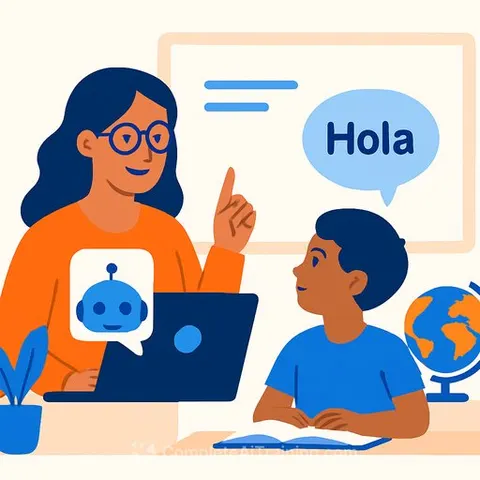
K-12 teachers are deploying AI-powered chatbots to help emergent bilingual learners master academic content and practice English, while Harvard researchers study how these tools can adapt materials without widening existing gaps. The approach offers new ways to scaffold instruction and engage families, but experts caution that speech recognition errors and unequal device access could undercut the benefits.
Chatbots as instructional supports
Daniel Gomez, who teaches bilingual humanities and social studies at the Ideal School in Tampa, Florida, sees AI filling a critical need. "Teachers in general cannot be knowledgeable about every single subject," he said, and certainly not across multiple languages. AI can step in: "It will be able to pick up any topic students are interested in and handle the topic reasonably well."
Ying Xu, an assistant professor of education at Harvard, said researchers are exploring how AI can provide scaffolding in a child's home language. "For example, a multilingual language model might keep the core learning content in English while offering explanations, prompts or supports in the child's home language," she said.
Krystle Salas, assistant director of special populations at Second Mile, which runs alternative charter schools for at-risk students, noted that bilingual learners often lack access to classroom conversations and materials at the level of their peers. A chatbot can give them "pieces of the content in Spanish or give them smaller sentences that are simpler," she said.
Melissa Henning, K-12 educational content manager at The Source for Learning, highlighted the confidence-building aspect. "Maybe I don't want to talk in English in front of other people, but I'll talk in English to the chatbot because the chatbot doesn't care if I'm doing it wrong," she said. The chatbot can then help rephrase what the student meant to say.
Stephanie Howell, an education strategist and ISTE Certified Educator, uses SchoolAI as a "guide on the side" for her second- and third-grade intervention students. She sets the AI to allow productive struggle on a first wrong answer, then provide a sentence starter on a second miss. The tool also helps her analyze vocabulary that might trip up her students, freeing time for one-on-one instruction. These efforts reflect a growing interest in AI for Education, where tools are being tailored specifically for multilingual classrooms.
Bridging the home-school language gap
Chatbots can also draw families into learning. Henning pointed out that many Spanish-speaking parents receive English-language schoolwork their children can't discuss at home. With a chatbot translating simultaneously, "they can actually use both languages at the same time to build concepts," she said. Teachers can prompt a bot to send a nightly question tied to the day's lesson, giving non-English-speaking parents a way to have a conversation about that content.
Navigating risks and limitations
Xu warned that inaccuracies in speech recognition for bilingual children could backfire. "Many AI systems are still less accurate at recognizing bilingual children's speech, especially when children have accented speech or dialectal variation or are moving between languages," she said. This can lead to flawed assessments and reduced benefit from the tools.
The digital divide poses another threat. "You want to make sure that we're not widening the gap because they don't have devices available at home or they don't have internet at home," Henning said. And while some chatbots allow students to type in their home language, Howell cautioned that teachers must decide based on the learning goal: "Sometimes as a teacher, I can't have my students go back and forth because they have to learn it in English."
Gomez stressed that educators can customize AI models to suit their needs-training them on everyday vocabulary or technical terms-but the teacher's voice must remain central. "Even though AI can be a very valuable tool - it can help with a great many things - you always need that human touch," he said. Salas echoed this: "A teacher can read their emotions; they can see the full context of the situation and adjust in real time. And AI can make mistakes, so we always want to make sure the majority of the instruction and support is coming from the humans."
Why this matters for educators
For K-12 teachers and administrators, AI chatbots offer a practical way to differentiate instruction for emergent bilingual students and involve families who don't speak English. But the tools are only as effective as the infrastructure and human oversight behind them. The concrete takeaway: test chatbots for accent recognition accuracy with your own student population, set clear language-switching rules tied to learning objectives, and prioritize human-led instruction while using AI as a supplement. Without those guardrails, the same tools meant to close gaps could quietly widen them.