
AI news ·
Tech companies cut middle managers as AI takes over coordination work, leaving employees with less support and fewer paths to promotion
Middle manager jobs in the U.S. fell 42% by end of 2025 from a 2022 peak. At Block, some managers now oversee 175 direct reports-up from the typical six to 12-straining mentorship and career growth.
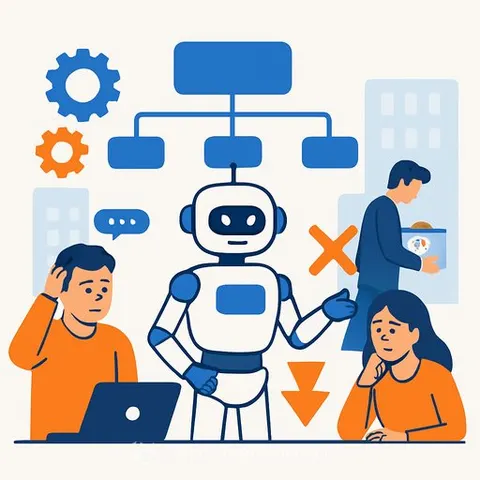
Tech Companies Are Cutting Middle Managers. Workers Say It's Backfiring.
Meta, Amazon, Block and Coinbase are slashing management layers as part of AI-driven restructurings, but the move is creating unsustainable workloads and eroding mentorship and career advancement for employees across Silicon Valley.
When tech CEOs announce AI investments, they promise to flatten organizational structures by removing what they call unnecessary management layers. Coinbase laid off 14% of its workforce last week with this rationale. Amazon, Block and Meta have followed similar playbooks over the past year, each cutting tens of thousands of employees with a specific focus on reducing management.
The trend reflects a real shift in how work gets distributed. As AI tools handle routine tasks, companies are asking remaining managers to both supervise and produce code themselves-vastly expanding their responsibilities. At the same time, managers are expected to oversee more people with less support.
The Numbers Tell a Stark Story
Openings for middle manager jobs in the US fell 42% by the end of 2025 compared with a peak in 2022, according to workforce data platform Revelio Labs. Managers made up 13% of the US workforce in 2022.
Block's restructuring illustrates the scale of change. Some engineering managers now oversee as many as 175 direct reports under the company's new AI-oriented structure, according to internal organization charts. Previously, managers typically handled six to 12 reports.
Block CEO Jack Dorsey has stated the company has "no need for a permanent middle management layer." His goal is eventually to have all 6,000 employees report directly to him, minus management tiers.
What's Actually Happening on the Ground
Prateek Singh, a software development manager at Meta, saw the pressure firsthand. Within months of joining in June 2025, his direct reports jumped from manageable numbers to seven. He was also expected to write code himself-a departure from Meta's traditional model where managers delegated and guided.
To cope, Singh switched one-on-one meetings from weekly to every other week. He used AI agents-bots that execute tasks without human intervention-to collect updates and provide feedback between meetings. While the system functioned, Singh saw the risks.
"If managers are expected to either be writing a lot more code or have a lot more reports, what I see happening is more asynchronous, agent-driven management," Singh said. "Then people lose touch with all the benefits you get from face time-mentorship, human judgment and guidance."
He left Meta at the end of April. "I didn't want to be the guinea pig," he said.
The Hidden Costs
Fewer management layers means fewer opportunities to advance. Employees lose access to mentorship and human support at a time when their own jobs are getting harder.
Emily Rose McRae, an analyst at Gartner who studies AI's impact on work, said the pressure on middle managers will intensify an already difficult job. Surveys show many managers across industries would choose not to be managers if given the option.
"What that means for employees is that your job gets harder, too," McRae said. "When your manager doesn't get the support they need, you don't get the support you need."
Freeland Abbott, a former technical lead at Block's Square division, worries that critical human elements of management will disappear. "AI can't provide team motivation, human connection or support in the way a person can," he said. Offloading employee development to same-level colleagues could disadvantage less-experienced and marginalized teams, he added.
Speed vs. Reliability
Flatter structures may accelerate decisions, but they create new problems. With fewer layers to review work, mistakes move faster through organizations. One team's increased output can overwhelm the team responsible for approving it.
Singh flagged another risk: managers under pressure might rely on AI for decisions and blindly accept flawed suggestions. As other teams build on those decisions, the errors compound. "That could lead to data leaks, security holes or even system outages," he said.
Matthew Bidwell, a management professor at Wharton, said there's a trade-off companies may not fully grasp. "You'll move faster, but you'll break more things, and for some organizations that's probably not the right trade-off," he said.
Will This Actually Stick?
Bidwell points out that companies have tried to break hierarchies before. Most experiments fail or remain isolated cases.
Raffaella Sadun, a Harvard professor studying the future of work, said tech companies are better positioned than legacy industries to make radical changes because they're already advanced technologically. But even they will face friction, especially if changes happen suddenly.
Abbott doesn't expect Block's extreme management ratios to last. "Companies will recognize the need for more humans even if the role isn't called a 'manager,'" he said.
For now, managers are navigating uncharted territory. Anastassia Fedyk, an assistant professor at UC Berkeley's Haas School of Business, said as AI tools shift work from managers to their reports, these structural changes could become permanent. That depends entirely on whether companies can solve the problems that emerge first.
Learn more about AI for Management and how to adapt your leadership approach in an AI-driven organization.