
AI news ·
Telus and federal government announce three AI data centres in B.C. to expand sovereign computing capacity
Canada and Telus will build three AI data centres in B.C., backed by $2 billion in federal funding. Two open in Vancouver this year; a third follows in 2029.
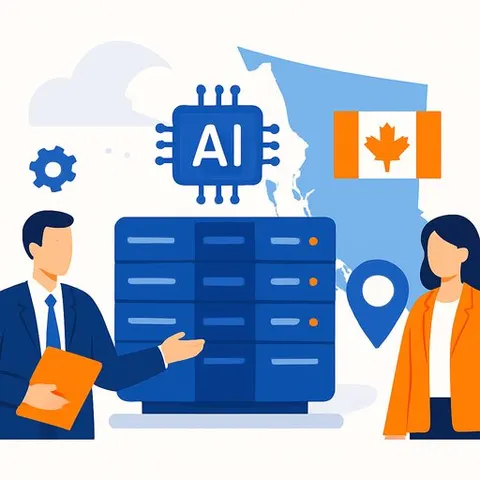
Canada announces three AI data centres in B.C. to build sovereign computing capacity
The federal government and Telus announced plans Monday for three artificial intelligence data centres in British Columbia, committing to what officials describe as an effort to build Canadian-controlled AI infrastructure. Two facilities will be built in Vancouver and one will expand Telus's existing operations in Kamloops.
The federal government has committed $2 billion over five years, starting in 2024-25, to identify and support large-scale sovereign data centres. The project emerged from a federal call for proposals that ran from mid-January to mid-February this year.
Artificial Intelligence Minister Evan Solomon said at a Vancouver news conference that the investment carries financial risk but is necessary for Canada to remain competitive. "Of course, there are financial risks when people are investing billions of dollars," he said. "We're going to take on an element of risk, but you also have to do that boldly and responsibly."
Timeline and capacity
The Kamloops expansion and the Mount Pleasant Vancouver facility will open later this year. The downtown Vancouver facility will come online in 2029.
Outgoing Telus chief executive Darren Entwistle, who retires at the end of June after 26 years in the role, called the project a "seminal announcement" for Canada's economic future. He said the processing power will be sufficient to run the world's most advanced AI models, with all computations occurring on Canadian soil and controlled by Canadian infrastructure.
Sustainability and heat recovery
Telus said the three data centres will draw more than 98 per cent of their electricity from renewable sources. Waste heat from the two Vancouver facilities will be redirected to heat homes in the city.
Safety and sovereignty
Solomon acknowledged that AI for Government decisions come amid heightened federal scrutiny of AI safety. In February, a mass shooting in Tumbler Ridge, B.C., involved a shooter who had troubling interactions with ChatGPT that OpenAI flagged but did not report to police.
Solomon said the data centre project should not be conflated with AI safety concerns. He added that an examination of AI safety protocols is ongoing and "all options are on the table." He stressed that building sovereign AI infrastructure does not mean isolating Canada from global technology.
"We are building sovereign AI under Canadian law, but we are still going to have Canadians use technologies from around the world, including things like ChatGPT," Solomon said. "Sovereignty is not solitude, but we have an obligation to protect Canadians, to protect children, and that means making sure it's safe, reliable, transparent, and subject to Canadian law."
Opposition criticism
Conservative shadow AI minister Ben Lobb characterized the announcement as unnecessary government involvement. "Canada should already be a hub for AI data centres," he said. "They don't need government involvement or tax dollars; they just need the Liberal government to get out of the way."
Lobb called for the federal government to remove what he described as anti-development regulations and taxes rather than fund data centre projects directly.
The federal government said the project will support domestic innovation through partnerships with academia and industry. Learn more about Generative AI and LLM infrastructure and applications.