
AI news ·
Temasek lifts China exposure by $7.7 billion and commits to doubling AI investments
Temasek added $7.7 billion to its China holdings, though its portfolio share fell to 17 percent. It also plans to double its global AI allocation to 15 percent by 2031.
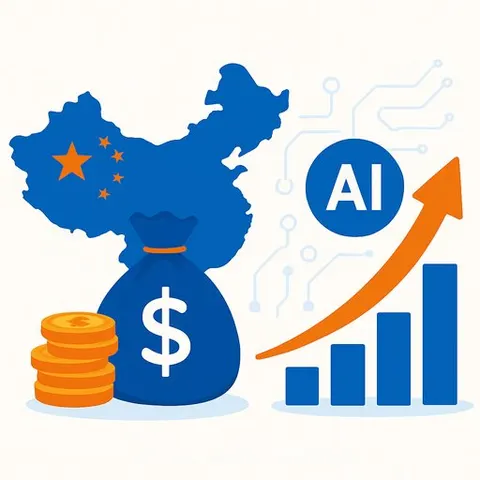
Temasek boosted its China exposure by S$10 billion ($7.7 billion) in the latest reporting period, even as the country's share of the portfolio slipped to a decade low of 17 per cent. The $400 billion Singaporean sovereign wealth fund is betting that the world's second-largest economy will shift toward innovation and consumption-led growth, and it plans to double its global AI allocation to 10-15 per cent of assets by 2031.
Over the past decade, Temasek's investments in China have grown by S$24 billion ($18 billion). The portfolio percentage dipped from 18 per cent in 2025 to 17 per cent at the end of March 2026, mainly because the fund's total assets grew faster than its China holdings. Singapore remains the largest geographic exposure at 27 per cent, followed by the US at 26 per cent, then China.
China exposure climbs, but portfolio share dips
"We remain committed to investing in China, and continue to invest in the promising areas," said Temasek Holdings chief executive Dilhan Pillay in a media briefing. He added that valuations have rebounded since 2024. The fund's top holdings in China include Tencent, a top-five position, and insurer Ping An, which sits among the top 10.
China's strong exports tied to AI and technology are positive signals for Temasek, though the fund noted that reflation "remains uneven and not yet broad-based." It expects further policy easing from the government is "unlikely," even as domestic consumption lags. The CSI 300 index rose nearly 20 per cent in the past year, driven by opportunities in AI and robotics, but that gain is modest compared to the 138 per cent surge in South Korea's KOSPI index.
Innovation and AI drive the China thesis
Temasek will increase its allocation to "tech-enabled" businesses and life sciences in China, rooted in the belief that the country will transition to innovation and consumption-led growth. The fund's China portfolio delivered resilient long-term performance over the past two decades, though the exposure weighed on returns between 2021 and 2024, pulling the five-year total shareholder return to 4.6 per cent.
"Our China portfolio has delivered resilient long-term performance over the past two decades and this track record underpins our continued investments in the market," the fund said in its annual report. Private equity deal value in China surpassed $230 billion in 2025, with state-owned enterprises active in mega deals over $1 billion, according to a PwC China report.
Global AI push: 10-15 per cent target by 2031
The fund's AI enthusiasm extends well beyond China. The thematic currently represents 6 per cent of the portfolio, and Temasek aims to reach 10-15 per cent by March 2031. Its investment approach is four-pronged: backing established AI winners, emerging innovators, core-plus infrastructure like data centers and energy assets, and companies that are demonstrably using AI to transform products and operations. This strategy is a clear example of how large asset owners are navigating AI for Executives & Strategy.
"This approach balances larger investments in the most significant AI beneficiaries across industries with selective exposure to high-potential AI-native companies," the fund said. It will also engage with boards of Singaporean and global portfolio companies to scale their AI capabilities, tying the effort to stewardship principles.
AI-proofing the portfolio with Aicadium
An important platform for Temasek's AI-proofing work is Aicadium, which the fund set up in 2021 to provide AI engineering capabilities to portfolio companies. Aicadium helped industrial testing firm Element develop a tool that combines Element's insights with generative AI to advise medical device companies on the FDA approval process. This practical application of AI connects directly to AI for Finance and broader operational transformation.
"Our overall approach to AI-proofing our portfolio is focused on both near-term execution progress and longer-term value uplift," the fund said. It also plans to expand core-plus infrastructure from 1 per cent to 5 per cent of assets and private credit from 2 per cent to 5 per cent by 2031. A standalone private credit platform, Aranda Principal Strategies, now manages a S$13 billion ($10 billion) portfolio of funds and direct investments.
Why this matters for finance, IT, and development professionals
For finance professionals, Temasek's shift toward private credit and infrastructure signals a deliberate move to diversify equity-heavy portfolios and capture recurring cash yield, while the rising AI allocation points to sectors where valuations and deal flow are likely to concentrate. IT professionals can look at the Aicadium model as a blueprint for embedding AI capabilities into legacy industrial companies, not just tech-native startups. Development teams and strategists should note the fund's long-term conviction in China's technology and consumption transition, despite uneven near-term reflation-a stance that may influence capital flows and partnership opportunities in the region.