
AI news ·
Therapists are using AI to record sessions, raising concerns about patient consent and privacy
Therapists are using AI tools to record sessions and auto-generate clinical notes, but patients report feeling violated when not properly informed. Only 11% of Americans say they'd be open to AI in mental health care.
Therapists Turn to AI Note-Taking. Patients Worry About Privacy.
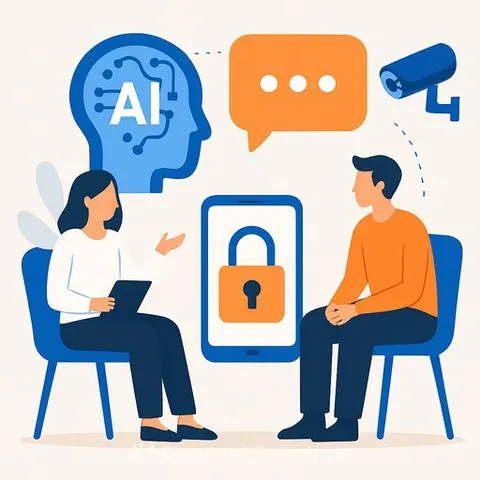
A growing number of therapists are using artificial intelligence tools to record sessions, transcribe conversations, and generate clinical notes automatically. Software companies say the technology saves hours of administrative work each week. But patients and ethics experts are raising serious questions about consent, data security, and whether the presence of AI fundamentally changes the therapeutic relationship.
Molly Quinn, a 31-year-old librarian in Fayetteville, Arkansas, discovered her therapist was recording a session without her explicit consent. She had asked to research the AI tool first. Halfway through that session, she noticed her therapist's iPad propped up instead of taking notes by hand. Quinn realized the session was being recorded.
"The more I thought about it, the more I just started getting more and more sick to my stomach," Quinn says. "This person who I'm supposed to be able to trust with some very private and very intense emotions had just completely disregarded something I said I was not comfortable with. I felt completely violated."
Quinn canceled her next appointment. When her therapist offered to stop using the tool, the damage was done. "The trust was gone," Quinn says. She found a new therapist and made clear from the start that she did not want AI in her sessions.
How the Technology Works
Companies like Berries, SimplePractice, and Blueprint offer AI documentation systems to mental health providers. The tools record conversations, transcribe them, and generate draft notes that therapists review before finalizing. Charges range from $19 to $99 per month, targeting solo practitioners overwhelmed by paperwork.
Berries CEO Tal Salman told NPR that audio is automatically deleted after each session and transcripts are stored on HIPAA-compliant U.S. servers. "Therapy session content remains private and is not repurposed for training," Salman said. "The clinician remains fully responsible for patient care and the final documentation."
The administrative savings are real. Most clinicians spend about 10 hours a week on administrative tasks, with 5 to 7 hours dedicated to documentation. Kym Tolson, a therapist who runs a fully remote practice while traveling, says the AI system cut her documentation time from 15 to 20 minutes per client to about 2 minutes.
"It's given me my life back," Tolson says. "I don't have notes following me around, haunting me. After I see my client, I review the note, sign it and I'm done."
The Consent Problem
Kellie Owens, an assistant professor of medical ethics at NYU Grossman School of Medicine, says written consent forms are not enough. "We have a wide body of research showing that a consent form on its own does not mean a person is making an informed choice," Owens says. "People scroll through them, don't read them or feel pressured to agree."
Owens recommends that any recording should require a direct verbal conversation. "Any time you are recording a conversation, that should require a verbal conversation that a recording is taking place," she says.
Patient surveys show limited appetite for AI in mental health. A YouGov national survey found that only 11% of Americans say they would be open to using AI for mental health care, and just 8% say they trust it. Nearly half said they are reluctant to use the technology, citing lack of human understanding and privacy concerns.
A separate survey from KFF found that about 77% of Americans worry about how their health information would be stored and used by AI systems.
Data Breach Risk
HIPAA compliance does not eliminate breach risk. "Regardless of what protections we have in place, that doesn't mean data can't be breached," Owens says. "There are plenty of systems that are fully HIPAA compliant that still experience major data breaches."
Healthcare systems and major corporations have faced repeated data breaches in recent years. Quinn worries that adding another layer of technology increases the chance deeply personal conversations could be exposed. "We're going to see breaches," she says. "Maybe not tomorrow, maybe not next week. But in a few years? I think we're going to see them. And I don't want my therapy session to be part of that."
The Invisible Third Party
Marisa Cohen, a couples and sex therapist in New York, says introducing AI into therapy changes the experience, even if the technology stays in the background. "Even the presence of AI changes the therapeutic experience," Cohen says. "Clients know or feel like something else is listening to them. That awareness can subtly alter their disclosure."
Therapy relies on the perception of absolute privacy. "When you introduce something that's being stored electronically, it raises additional questions about trust and safety," Cohen says. "It's essentially a third party."
Cohen also flags accuracy concerns. "If errors are introduced and a clinician isn't carefully checking the notes, that error is now part of the record," she says. "If those notes are ever subpoenaed, that becomes part of someone's history."
Tolson acknowledges that AI systems can hallucinate. "The clinician has to be very careful. You have to double- and triple-check," she says. She reviews each AI-generated note before it enters the medical record and discusses the recording process in detail with clients beforehand, making participation optional.
The Bottom Line
The technology addresses a real problem: clinician burnout and administrative overload. But it introduces new tensions around consent, privacy, and the nature of the therapeutic relationship itself.
For healthcare professionals considering these tools, the question isn't whether they work - they do save time. The question is whether the time saved justifies the erosion of trust that can occur when patients feel their privacy has been compromised.
For more on how AI is being integrated into healthcare settings, see AI for Healthcare and AI Privacy and Data Security.