
AI news ·
Frontiers and World Economic Forum unveil top technologies to accelerate climate and planetary health solutions
Frontiers and the World Economic Forum released a climate technology list on October 15. Selected innovations must be ready for deployment within three to five years.
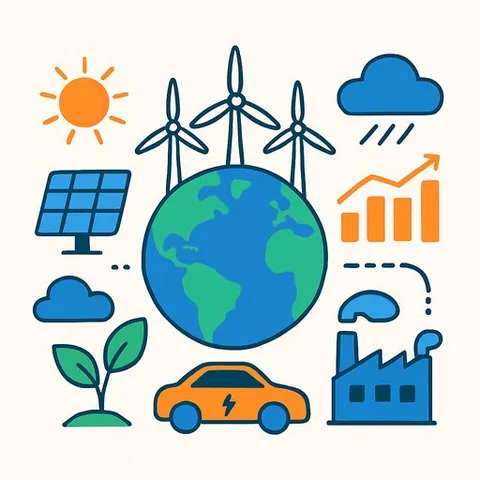
Frontiers and the World Economic Forum released a joint list of top emerging technologies on October 15, identifying innovations they believe can accelerate solutions for climate change and planetary health. The announcement, made during a WEF gathering, targets technologies ready for scaling within the next three to five years.
The selection process drew on expertise from Frontiers' network of scientific editors and the WEF's global platform. The organizations focused on technologies with a clear path from laboratory validation to real-world deployment. Unlike broad trend reports, this list names specific technical approaches that have moved past the proof-of-concept stage.
What the list includes
While the full roster of technologies was not detailed in the initial release, the framing points to areas where scientific research intersects with immediate environmental need. Previous collaborations between these organizations have highlighted fields such as carbon capture materials, advanced battery chemistry, AI-driven climate modeling, and synthetic biology for sustainable materials.
The emphasis sits on "planetary health" - a term that links human well-being directly to the state of natural systems. This framing brings together disciplines that often operate in separate silos: climate science, ecology, public health, and materials engineering.
The selection criteria
The WEF and Frontiers applied a specific filter. Technologies had to demonstrate potential for large-scale impact within a defined window. The organizations also assessed whether the necessary governance, investment, and supply chain structures exist to support rapid adoption. This is not a list of distant possibilities. It is a list of technologies where the bottleneck is no longer the science itself, but the speed of industrial translation.
Jeremy Farrar, Chief Scientist at the World Health Organization, has previously spoken about the need for such cross-sector prioritization. In related WEF discussions, he said: "The climate crisis is a health crisis, and we need to bring the same urgency to planetary health that we brought to pandemic response."
Why this matters for science and research professionals
For researchers and lab leads, this list signals where funding and institutional attention are likely to concentrate over the next funding cycle. Technologies named in WEF-Frontiers collaborations often see accelerated grant flows and new public-private partnership models. Scientists working in adjacent fields can use the list to identify where their work intersects with prioritized global challenges.
For those in development and IT roles, the announcement points to a growing demand for infrastructure that supports climate technology deployment at scale. This includes data pipelines for environmental monitoring, platforms for managing distributed sensor networks, and the computational frameworks needed to run high-resolution climate models. Professionals who understand how to build and maintain these systems will find their skills in direct demand. The AI Learning Path for Sustainability Analysts maps to this exact intersection of technical skill and environmental application.
Why this matters for healthcare and general audiences
The planetary health framing connects environmental changes to direct health outcomes. Heat stress, vector-borne disease expansion, and respiratory illness from air pollution are all areas where technology can improve both prediction and response. Healthcare professionals should expect to see more diagnostic and monitoring tools that account for environmental variables. General audiences, meanwhile, will encounter these technologies through policy changes, new consumer products, and shifts in how cities manage resources like water and energy.
The WEF and Frontiers have not yet published the complete list. Their announcement establishes the framework and signals that the detailed report will follow through Frontiers' open-access channels.