
AI news ·
Trump buys Nvidia shares days before US approves AI chip sales to China
Trump bought up to $5M in Nvidia stock days before key administration decisions on AI chip exports to China. Ethics watchdogs are questioning the timing of the trades.
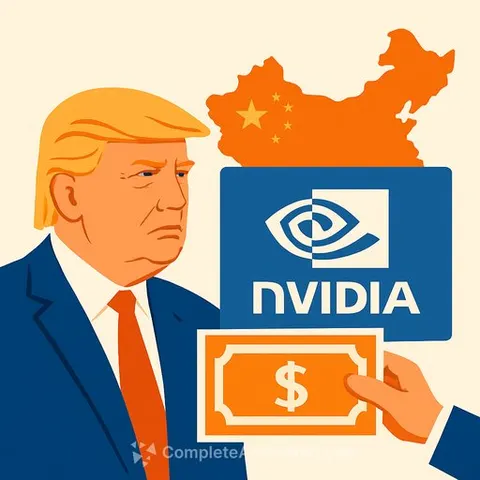
Trump's Nvidia Trades Raise Questions About Government Decisions on AI Chips
Government records show President Donald Trump personally bought and sold millions of dollars in technology company shares earlier this year, including significant positions in Nvidia, the world's most valuable chip manufacturer. The timing of these trades relative to administration decisions on AI chip exports has drawn scrutiny from ethics watchdogs.
Trump purchased between $1 million and $5 million in Nvidia shares on February 10. One week later, Nvidia announced a major artificial intelligence deal with Meta. In January, Trump bought between $500,000 and $1 million in Nvidia stock, followed days later by a Commerce Department approval to sell certain Nvidia AI chips to China.
The pattern matters because the U.S. government tightly controls exports of advanced AI chips to countries it considers strategic rivals. Nvidia controls a dominant share of the market for chips that power everything from AI systems to military applications.
Why Nvidia's Position Matters
Nvidia designs the processors that run modern AI systems. Before stricter U.S. export restrictions took effect, the company controlled roughly 95 percent of China's advanced AI chip market, generating about 13 percent of Nvidia's total revenue. CEO Jensen Huang has valued China's AI market at $50 billion annually.
The company is also a major U.S. government contractor and a favored investment during the global AI expansion.
White House Response
U.S. ethics law requires presidents to disclose stock trades, though only in broad dollar ranges. The White House said Trump does not directly control these investments. According to the Trump Organization, outside financial firms manage the president's portfolio independently.
After the story became public, the White House stated Trump's assets are managed through a trust run by his children and said there were "no conflicts of interest."
Delayed Chip Sales to China
During a recent visit to China, Trump approved sales of Nvidia's H200 AI chips to approximately 10 Chinese companies, including Alibaba, Tencent, ByteDance, and JD.com. Distributors like Lenovo and Foxconn also received approval.
Chinese companies have slowed purchases following guidance from Beijing. China is attempting to reduce dependence on American technology and increase investment in domestic chip makers like Huawei.
The delay reflects intensifying technology competition between the two countries. Nvidia faces pressure from tighter U.S. export rules while Chinese AI firms increasingly promote domestic alternatives to Nvidia products.
A Company Caught Between Superpowers
Nvidia remains the world's leading AI chip manufacturer, but operating between the U.S. and China has become more difficult. As both countries compete for AI leadership, global tech companies face conflicting pressures from Washington and Beijing.
For government officials and policymakers, understanding these dynamics is essential. The intersection of personal investment, government contract awards, and export policy decisions affects how AI technology develops and deploys across sectors. AI for Government professionals should track how these tensions shape policy, while AI for Executives & Strategy resources can help leaders navigate similar conflicts between investment interests and institutional responsibilities.