
AI news ·
Trump pulls AI safety order after David Sacks calls president to raise objections
Trump pulled back an executive order requiring federal review of advanced AI models after a late-night call from venture capitalist Marc Sacks, who argued the process would hurt U.S. competitiveness with China.
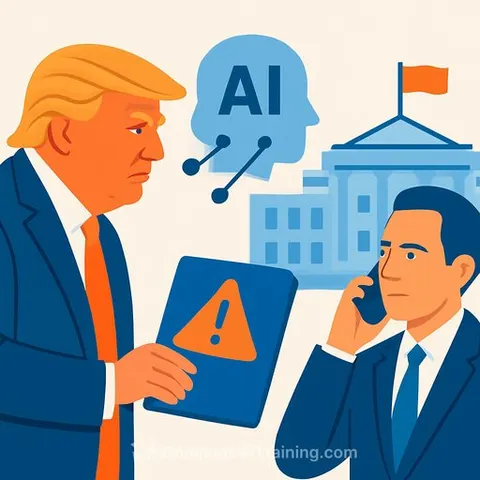
Trump Delays AI Review Order After Industry Pressure
President Trump postponed signing an executive order requiring federal review of advanced AI models before public release, citing concerns that the process would slow U.S. innovation and disadvantage American companies against China.
The delay came after Davos venture capitalist Marc Sacks called Trump directly Wednesday night to raise objections, according to a senior White House official. Sacks had previously participated in reviewing the order and White House staff believed he supported it.
"Then, he called POTUS this morning unbeknownst to anybody, his own staff included, and derailed it," the White House official said.
Sacks told Trump that companies were already cooperating voluntarily and that government model review would harm America's competitive position in AI development. He did not respond to requests for comment.
Industry Split Over Requirements
The proposal faced mixed reactions across the tech industry. OpenAI, which developed one of the most advanced AI systems, supported the order's general approach. The company's top lobbyist said OpenAI believed in collaborating with government on AI safety while maintaining the ability to innovate.
Other industry leaders opposed specific elements. Executives pushed the White House to shorten the timeline for sharing new models from 90 days to 14 days, according to four people with knowledge of private discussions. They also requested that the intelligence community lead the review process rather than other agencies.
Several leading tech CEOs who were invited to the signing ceremony on short notice could not attend. OpenAI, Anthropic, and Meta planned to send lower-level executives instead, which contributed to the rollout's collapse.
What the Order Proposed
The draft order would have required voluntary submission of advanced "frontier" AI models for government review. It explicitly stated that nothing in the order would create mandatory licensing, preclearance, or permitting requirements for AI development.
The National Security Agency would have had final authority to designate which systems qualified as covered frontier models. Other agencies would have established a classified benchmarking process within 60 days.
Trump told reporters Thursday that he objected to unspecified aspects of the order. "I think it gets in the way of - we're leading China. We're leading everybody, and I don't want to do anything that's going to get in the way of that," he said.
Learn more about generative AI and LLM governance and AI policy for government.