
AI news ·
Trump signs executive order giving government 30-day window to review new AI models
Trump signed an order Tuesday requiring tech companies to voluntarily submit new AI models for government review before release. The 30-day review window is shorter than an earlier proposal that industry leaders had opposed.
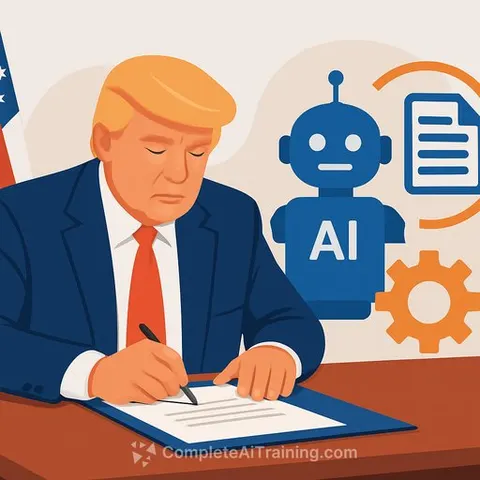
Trump Signs AI Oversight Order, Reversing Hands-Off Approach
President Trump signed an executive order Tuesday requiring technology companies to voluntarily submit new artificial intelligence models to the government for review before public release. The order marks a significant shift from the administration's previous stance of minimal regulation on AI development.
Under the order, the government has up to 30 days to review AI models. The Treasury Department will also establish an "AI cybersecurity clearinghouse" to assess security vulnerabilities in new systems.
The decision follows months of internal debate over balancing national security concerns with economic competitiveness. Last month, Trump scrapped a similar order that would have allowed 90 days for review-a timeline tech executives warned would slow development and disadvantage American companies against China.
What Changed
David Sacks, the administration's former AI czar who had opposed the 90-day review window, agreed to support the revised order after the timeline was cut to 30 days. That shift proved decisive. White House chief of staff Susie Wiles, a proponent of oversight, worked to revive the order after it was canceled.
The April announcement of Anthropic's Mythos model-which could identify software vulnerabilities-prompted government officials to act. Concerns that adversaries could exploit such capabilities accelerated the push for formal oversight.
Industry Response
Executives from Microsoft, OpenAI, Google, and Anthropic publicly supported the order as balancing safety and innovation. Several had opposed the 90-day timeline, arguing it would delay product launches and undermine American competitiveness.
Some executives view participation in the voluntary program as a way to address public concerns about AI safety. Others worry the order could eventually lead to stricter mandatory requirements.
Meta did not immediately comment. Sam Altman, OpenAI's chief executive, is scheduled to meet with Trump on Wednesday.
Political Pressure
Trump faced pressure from multiple directions. MAGA allies including Stephen Bannon and Amy Kremer signed a letter urging mandatory vetting of AI models, warning that companies cannot be trusted to police themselves. A rally is planned for Wednesday in Washington calling for safety testing requirements.
Public opinion on AI has shifted. A March Quinnipiac University poll found 55 percent of American adults view AI as a force for harm rather than good, citing concerns about jobs, energy costs, education, and mental health.
Brendan Steinhauser, chief executive of the Alliance for Secure AI Action, said the group prefers mandatory oversight but expects voluntary compliance will be widespread given the order's importance to Trump.
What's Next
The order signals the administration now sees AI regulation as a national security issue, not merely an economic one. Whether companies will comply uniformly with the voluntary framework-or whether Congress will move toward mandatory requirements-remains unclear.
Learn more about AI for Government and Generative AI and LLM policy implications.