
AI news ·
Trump signs executive order linking AI deployment to federal cybersecurity modernization
Trump signed an executive order June 3 requiring federal agencies to modernize cybersecurity systems as AI becomes embedded in critical infrastructure. A new AI security clearinghouse and 30-day action deadlines are central to the directive.
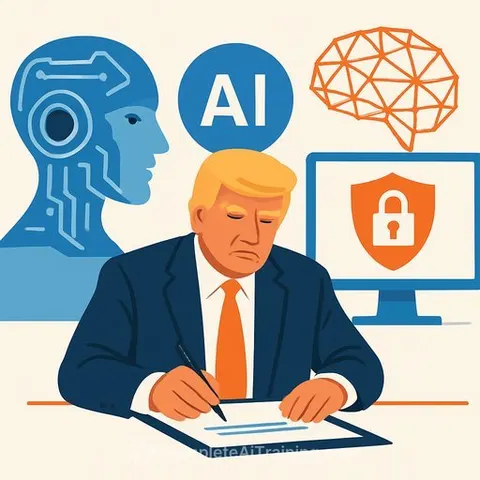
Trump Executive Order Ties AI Innovation to Cybersecurity Modernization
President Trump signed an executive order on June 3 directing federal agencies and private-sector partners to modernize cybersecurity systems as advanced AI capabilities become embedded in critical infrastructure. The order frames AI as both a competitive advantage and a national security vulnerability, requiring agencies to harden networks against foreign cyber threats and protect American intellectual property.
The directive establishes a 30-day timeline for immediate action across multiple fronts. The Committee on National Security Systems must prioritize protection of classified networks. The Department of Defense must accelerate cyber defense of its information systems. The Department of Homeland Security, through the Cybersecurity and Infrastructure Security Agency (CISA), must issue binding operational directives to protect civilian federal systems that support critical functions.
Expanding Access to Security Tools
The order seeks to make advanced security technologies more accessible to federal agencies, state and local governments, and critical infrastructure operators. A new AI cybersecurity clearinghouse, led by the Treasury Department and coordinated with the National Security Agency and CISA, will work with AI companies and infrastructure operators to identify software vulnerabilities, reduce duplication of effort, and accelerate security patch distribution.
The Office of Management and Budget will assess whether existing federal grant programs can support organizations developing AI-powered vulnerability detection systems. The Office of Personnel Management must expand federal hiring for cybersecurity specialists within 60 days through the U.S. Tech Force program.
Framework for Frontier AI Models
The order establishes a classified benchmarking process to evaluate AI systems and determine which models qualify as "covered frontier models." Federal agencies led by Treasury, the NSA, and CISA will develop these assessments within 60 days, with designation decisions made by the NSA Director in consultation with national security officials.
The order creates a voluntary framework allowing AI developers to engage with federal authorities before broader release. Developers may provide government access to advanced models for up to 30 days before public launch, subject to strict confidentiality and intellectual property protections. The framework explicitly states that these measures do not create mandatory government licensing, preclearance, or permitting requirements for AI development or distribution.
Industry Response: Access Versus Speed
Security experts offered mixed assessments of the order's approach. Duncan Greatwood, CEO of Xage Security, said the directive attempts to balance AI innovation with security concerns, but acknowledged the challenge of writing policy for rapidly evolving technology. He argued that as advanced AI capabilities proliferate across open-source and commercial ecosystems, organizations must assume attackers will gain access to powerful tools and focus instead on controlling what those systems can access and do.
Shachar Hirshberg, CEO of Artemis, said the order correctly prioritizes getting modern AI defense tools to institutions that need them. He emphasized that access alone solves nothing-organizations must close the speed gap between attackers, who operate in seconds, and defenders, who typically operate in hours.
Doc McConnell, head of policy and compliance at Finite State, raised a different concern. He argued that the order's emphasis on classified benchmarking, nondisclosure requirements, and limited early access pilots will slow adoption of frontier models by the broader cybersecurity community. McConnell said stronger cybersecurity requires more transparency and information-sharing, not less, and urged the federal government and AI labs to expand outreach beyond a small group of companies and agencies.
For executives overseeing security strategy, the order signals a federal expectation that AI will play a central role in defending critical systems. The tension between restricted access and broad deployment remains unresolved.
AI for Executives & Strategy courses cover policy decisions and strategic implications of AI deployment. AI Learning Path for Cybersecurity Analysts provides practical training for professionals implementing AI-enabled security measures.