
AI news ·
Trump signs executive order to integrate AI into military and intelligence operations
Trump signed an executive order June 2 directing the military and intelligence agencies to adopt AI systems, replacing Biden's 2024 policy. A 30-day voluntary security review for frontier models is now part of the framework.
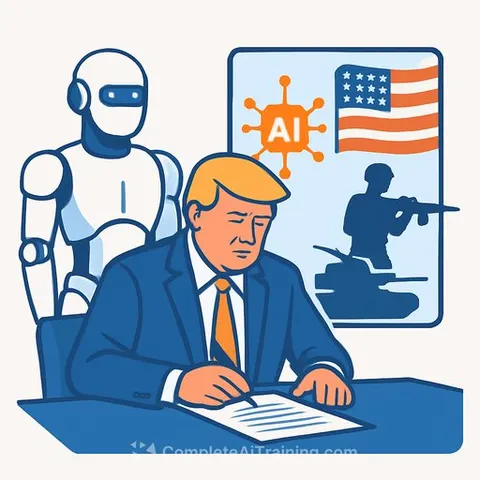
Trump signs AI directive for military and intelligence operations
President Trump signed an executive order on June 2 directing the federal government to integrate advanced AI systems across military and intelligence operations. A follow-up National Security Presidential Memorandum formalized the governance framework three days later.
The directive replaces the Biden administration's 2024 national security policy on AI, shifting toward faster adoption and broader deployment.
What the order requires
The executive order mandates three core actions:
- Voluntary federal vetting of advanced AI models before deployment, with a 30-day review window
- Creation of a talent reserve for AI-related national security work
- Strict government control requirements over AI systems used for national security, preventing unauthorized modifications
The Department of War and relevant military and intelligence agencies must implement these changes. The policy explicitly calls for integrating AI models from multiple private sector providers.
A classified annex will be released within 90 days of the signing.
The 30-day review window changes product timelines
The directive asks private sector AI companies to voluntarily submit frontier models for security review before release. For development teams, this introduces a new variable into launch schedules.
The policy prioritizes cybersecurity and protection of American intellectual property. Companies building advanced AI systems should expect the federal review process to affect go-to-market timelines.
Background
This order builds on Trump's 2025 America's AI Action Plan and a 2019 executive order on AI. The shift reflects a policy emphasis on speed and scale in federal AI adoption compared to the previous administration's approach.
For IT and development professionals working with government systems or federal contractors, understanding AI for Government policy changes is increasingly relevant to infrastructure planning and security requirements.