
AI news ·
Trump signs scaled-back AI cybersecurity order after rejecting stricter version last month
Trump signed an executive order Tuesday requiring AI companies to submit powerful new models for voluntary government review 30 days before public release. It replaces a stricter draft he rejected last month that had called for a 90-day period.
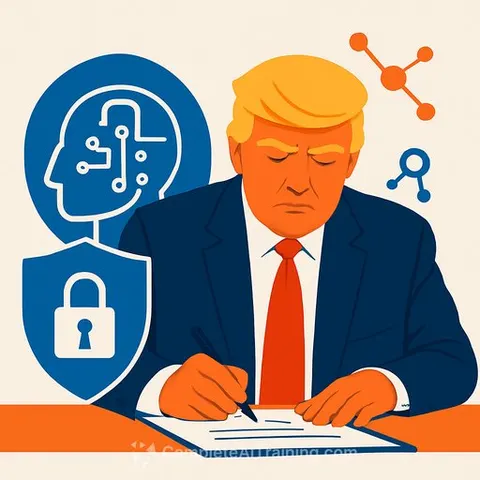
Trump Signs Scaled-Back AI Cybersecurity Order After Rejecting Stricter Version
President Donald Trump signed an executive order Tuesday requiring some AI companies to submit powerful new models for voluntary government review 30 days before public release. The directive addresses cybersecurity threats posed by advanced artificial intelligence but imposes less scrutiny than an earlier draft the president rejected last month.
Trump had been scheduled to sign a stricter version on May 21 that called for a 90-day review period. Hours before the ceremony, he rejected that draft, saying it would "get in the way of" U.S. competition with China for AI dominance. Former AI adviser David Sacks warned the president that the order would slow innovation.
The final order represents the latest shift in Trump administration AI policy, driven by competing factions within the White House. The administration has oscillated between seeking to ease regulatory burdens on AI developers and responding to national security concerns as models like Anthropic's Mythos have demonstrated ability to uncover vulnerabilities in critical computer systems.
What the Order Requires
The executive order directs the Treasury Department to establish a "cybersecurity clearinghouse" within 30 days in partnership with AI developers and critical infrastructure operators. The goal is to identify and patch security vulnerabilities uncovered by new AI models.
A classified benchmarking process will assess national security implications of advanced AI models. The National Security Agency director will oversee this effort in consultation with officials from the White House, Cybersecurity and Infrastructure Security Agency, and Pentagon.
The Pentagon must secure its networks within 30 days. The Justice Department will pursue criminal cases against individuals using AI models to conduct cyberattacks. Federal agencies have 30 days to issue directives strengthening defense of government networks.
Industry Skepticism Remains
Dean Ball, a former Trump AI adviser, said the order was "almost exactly similar" to the rejected May draft and expressed concern it sets the stage for more onerous oversight. He questioned what the intelligence community could accomplish in 30 days to make models safer.
The order explicitly denies creating "a mandatory governmental licensing, preclearance, or permitting requirement" for AI model development-language identical to the earlier draft.
The Broader Context
Anthropic's Mythos model, announced in April, prompted federal agencies to seek access to evaluate its capabilities. Researchers say the model has already discovered long-buried vulnerabilities in widely used computer systems.
JPMorgan Chase CEO Jamie Dimon has conveyed concerns to Treasury Secretary Scott Bessent about the speed of government response and the need for private sector coordination.
Trump received significant support from Silicon Valley executives for his 2024 election victory and came into office seeking to reduce regulatory burdens on AI. That approach has shifted as the administration grapples with security risks posed by rapidly advancing AI capabilities.
For government professionals evaluating AI policy, this order demonstrates the tension between innovation incentives and security requirements. Learn more about AI for Government and AI for Cybersecurity Analysts to understand how these policies affect implementation in federal agencies.