Trump mulls executive order to block state AI laws: What counsel needs to know
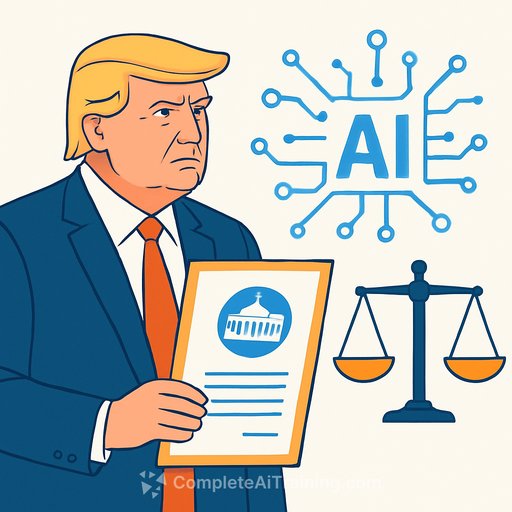
President Trump is weighing an executive order that would move federal agencies to challenge state AI regulations and push for a single national standard. A draft order would direct Attorney General Pam Bondi to stand up a task force to contest state measures deemed "onerous," seek limits on certain federal funds to those states, and instruct the Federal Trade Commission to issue a policy statement on how unfair and deceptive practices law applies to AI-and how it could preempt state AI laws.
"We remain in the earliest days of this technological revolution and are still in a race with adversaries for supremacy within it," the draft reads. "To win, American AI companies must be free to innovate without cumbersome regulation." The White House has not officially confirmed the draft; an official said any discussion before an announcement is speculation.
What the draft order appears to do
- DOJ task force: Directs DOJ to coordinate litigation, amicus briefs, and statements of interest challenging state AI laws on preemption and other constitutional grounds.
- Federal funding leverage: Seeks to condition or restrict certain grants for states that adopt AI rules labeled "onerous," subject to statutory authority and Spending Clause limits.
- FTC policy statement: Calls for guidance on how Section 5 (unfair or deceptive acts or practices) applies to AI models and where federal consumer-protection policy could conflict with, or displace, state rules.
Political backdrop
Efforts to impose a federal moratorium on state AI laws have split Republicans. A proposed ban was pulled from a tax package after pushback from tech-skeptical conservatives like Rep. Marjorie Taylor Greene. Talk of adding a preemption provision to the National Defense Authorization Act drew bipartisan resistance, with Sen. Brian Schatz calling it a "poison pill" and Sen. Josh Hawley saying it "shows what money can do."
Alabama Gov. Sarah Huckabee Sanders urged Congress to abandon a moratorium, pointing to GOP governors' defense of state measures such as Arkansas' AI child-exploitation law. Trump, however, publicly backed a single federal standard, warning that "overregulation by the states" could undercut AI investment and U.S. competitiveness.
Key legal questions (and likely arguments)
- Can an executive order preempt state law? Not by itself. An EO can direct agencies to assert preemption grounded in statutes or valid regulations. True preemption typically comes from Congress (express or implied) or from federal regulations with lawful authority, not from an EO alone. Expect DOJ to advance conflict and obstacle preemption theories against specific state provisions.
- FTC authority and preemption: A policy statement under Section 5 has no binding effect and doesn't itself preempt state law. The Commission could argue that certain state rules conflict with federal consumer-protection policy, but without an express preemption statute, success would hinge on conflict preemption and the specifics of the state rule. The "major questions" doctrine counsels caution if agencies claim sweeping preemptive power without clear congressional direction. For reference on Section 5, see the FTC Act overview here.
- Spending Clause constraints: Conditioning federal funds requires clear, related, and non-coercive terms. Overly punitive conditions risk the NFIB v. Sebelius problem on coercion. Any funding limits will need tight tailoring to program purposes and unambiguous notice. See NFIB v. Sebelius summary here.
- Anti-commandeering and federalism: The federal government can't forbid states from legislating in general. Preemption must target specific conflicts with federal law or regulation. States will argue consumer protection, privacy, and child-safety are traditional police powers, entitled to deference absent clear federal displacement.
- Dormant Commerce Clause: Some state AI rules may burden interstate commerce if they effectively regulate out-of-state model deployment. Expect Pike balancing arguments, while states point to local benefits such as transparency, safety, and fraud prevention.
How this might play out
- Short term: DOJ identifies target statutes for litigation. Agencies inventory grants where conditions could be adjusted under existing authority. FTC drafts a policy statement and solicits comment.
- Medium term: Lawsuits test the viability of conflict preemption and Dormant Commerce Clause claims against high-profile state laws (e.g., California's AI accountability rules, child-safety provisions). Courts parse whether federal consumer-protection policy meaningfully conflicts with state AI obligations.
- Congressional channel: Watch for riders in the NDAA or standalone bills that codify preemption or set a federal floor (or ceiling). Legislative clarity would do more work than an EO alone.
Action items for in-house and outside counsel
- Map obligations: Build and maintain a live matrix of enacted and pending state AI laws by product area (ads, biometrics, safety testing, provenance, incident reporting). Flag high-conflict items with federal consumer-protection doctrine.
- Dual-track strategy: Preserve arguments for federal preemption while budgeting to comply with strict states if challenges lag or fail. Document burdens, costs, and operational conflicts to support potential litigation or waiver requests.
- Grant exposure audit: For clients receiving federal funds, identify programs vulnerable to revised conditions. Prepare contingency plans if specific awards add AI-related strings.
- FTC watch: Prepare internal FAQs on unfairness/deception risks in model training, evaluation, disclosures, and security. Draft comment templates for an FTC policy statement or rulemaking docket that may open quickly.
- Product counsel checklist: Align model cards, safety testing documentation, and disclosure workflows with the strictest plausible standard. Tighten claims about AI capabilities to reduce Section 5 risk.
- Litigation prep: Assemble expert declarations on technical feasibility and interstate impacts. If your state regime has extraterritorial effects, preserve Dormant Commerce Clause arguments and record evidence for Pike balancing.
Signals to monitor
- The final text of any executive order and the scope of DOJ's task force mandate.
- Whether the NDAA or separate legislation carries a federal standard or preemption clause.
- FTC timing and the posture of any policy statement or enforcement guidance on AI.
- Early district court rulings on preemption challenges to marquee state AI laws.
Bottom line
An executive order can set the federal government's posture but won't, by itself, sweep state AI laws off the books. Real change will come from Congress, binding agency rules with clear statutory footing, or case-by-case wins on preemption and the Dormant Commerce Clause. Counsel should plan for both outcomes: a federal harmonization bid that takes time, and a continuing patchwork in the interim.
Updated at 6:26 p.m. EST
Your membership also unlocks: