AI Priorities in Ecommerce Operations: What the 2026 Delivery Benchmark Means for Your Team
Published: Mar 8, 2026
ShipStation's Ecommerce Delivery Benchmark Report 2026, developed with Retail Economics, makes one thing clear: AI is moving from pilot projects to core operations. The study surveyed more than 8,000 consumers and 400 retailers and found 90% of global retailers plan to increase AI investments in the next 12-24 months.
North America Is Moving Faster
North American merchants are advancing AI implementation ahead of Europe. In North America, 61% are actively growing AI usage and testing new applications, and 28% have already embedded and scaled AI across several functions. In Europe, 50% are expanding usage and 17% have scaled across multiple functions.
Delivery Expectations vs. Capability: The Gap
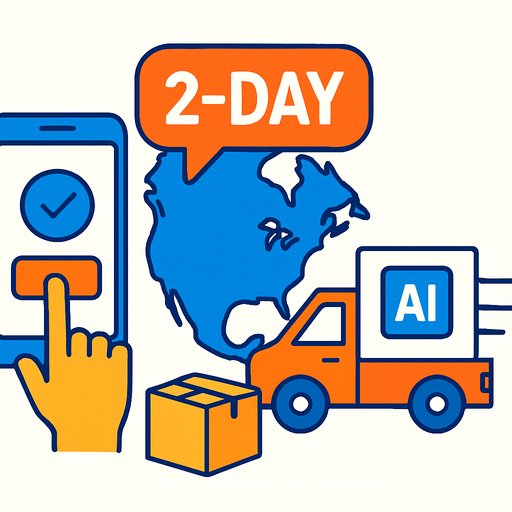
Consumer expectations are outpacing current offer sets. In North America, 59% of consumers expect two-day delivery, but only 40% of retailers offer it as a standard option. Price is tight too: consumers favor premium delivery priced at $5-$9, yet just 42% of U.S. retailers provide shipping in that range.
- Service-level design: If you can't hit two-day across the board, define where you can (zones, SKUs, membership tiers) and make it explicit.
- Pricing strategy: Align premium delivery fees near the $5-$9 sweet spot or justify higher fees with tangible value (speed guarantees, precise ETAs, proactive comms).
- Network and inventory: Revisit node placement, forward stocking, and split shipments to close the promise-to-deliver gap.
Where AI Will Have the Biggest Impact (Next 24 Months)
- Delivery execution (44%): Faster cycle times, higher tracking accuracy, and proactive notifications that cut "where is my order?" contacts.
- Predictive fulfillment (39%): Forecast-driven slotting, labor planning, and carrier selection to reduce costs and misses.
- Reverse logistics (26%): Smarter returns routing, automated dispositions, and fewer touchpoints.
"With so many businesses scaling their AI use, it's clear that AI is no longer a futuristic concept-it's a necessity for shippers looking to compete effectively and meet evolving consumer demands," said Kelly Vincent, chief product officer at Auctane, ShipStation's parent company.
What's Blocking Progress
Even with planned investment, teams are hitting friction. North American retailers cite adopting AI and emerging tech (33%), fulfillment costs (29%), and managing inventory across channels (26%) as top challenges.
- Smaller retailers (under $125M revenue): 53% say high AI development costs; 35% struggle with legacy integration.
- Larger retailers ($625M+ revenue): 47% point to limited skilled expertise/resources; 53% report customer resistance and lack of trust.
"We're here to help any size of business, small to large enterprise businesses, achieve growth, and that includes helping them understand how to use AI to their advantage," Vincent said. "We hope to clear a path for merchants to integrate AI and transform their fulfillment into a competitive advantage."
90-Day Action Plan for Operations Leaders
- Quantify your promise gap: Map current lead times, by lane and SKU, against the 59% two-day expectation. Flag the top five constraint clusters (cutoff times, pick-pack SLAs, carrier handoff, zone reach, inventory placement).
- Pilot delivery execution AI: Start with ETA accuracy and proactive alerts to reduce WISMO contacts and refunds. Use A/B regions to prove impact on NPS and contact rate before expanding.
- Stand up predictive fulfillment: Feed forecasts into slotting, wave planning, and carrier selection. Begin with two SKUs/facilities, measure touches/order, on-time performance, and cost/order.
- Tune premium delivery pricing: Test a $5-$9 tier in high-density zones. Track conversion lift vs. margin erosion weekly; adjust by basket size and membership status.
- Fix integrations early: Create an API-first playbook for WMS, OMS, TMS, and carrier data. Prioritize one integration that unlocks the most value (e.g., inventory visibility) and retire a brittle legacy handoff.
- Upskill your team: Equip managers on use cases, data readiness, and change control. See the AI Learning Path for Supply Chain Managers for practical, role-based training.
- Optimize last mile and routing: If fleet or regional carriers are in play, align initiatives with the AI Learning Path for Transportation Managers to improve route planning, dispatch, and exception management.
- Address trust head-on: For larger brands facing customer skepticism, publish how AI improves accuracy and transparency. Offer easy opt-outs for AI-driven communications and track complaint ratios.
- Lock in governance: Define model ownership, data quality SLAs, and rollback procedures. Report monthly on on-time delivery, contact rate, cost/order, and return cycle time.
Source and Methodology
The report was produced by ShipStation in partnership with Retail Economics. Consumer surveys were conducted in November 2025 with responses from 8,000+ nationally representative consumers. The study also included feedback from 400 senior decision-makers at ecommerce businesses with annual revenue of $12.5M+ across the UK, U.S., Germany, France, Spain, Italy, Canada, and Australia.
Your membership also unlocks: