
AI news ·
Two financial firms show how not to handle AI job cuts as threats and regulatory scrutiny follow
Two botched AI layoff announcements - one triggering a violence threat and police response, the other drawing regulators in two countries - offer insurance executives a clear warning on what not to do.
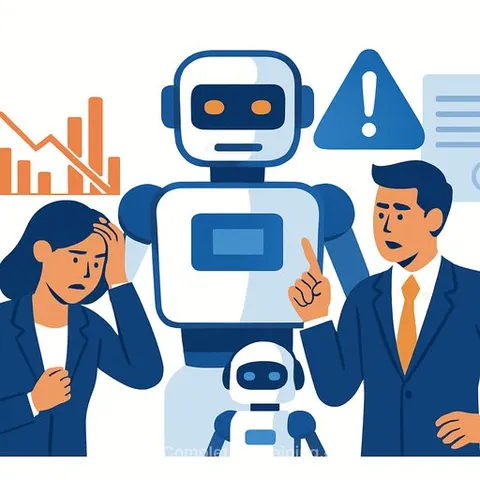
Two CEO stumbles show insurance how not to cut jobs for AI
Within two weeks, two major financial services firms bungled the announcement of AI-driven redundancies so badly they created security crises and regulatory scrutiny. The lessons for insurance executives are urgent.
WiseTech Global, an Australian logistics software company, announced in February it would eliminate 2,000 positions-nearly 30% of its workforce-over two years. CEO Zubin Appoo said some projects that took six or seven months could now be completed in a day. The share price rose. Staff morale did not.
Three months of delayed consultations, missed deadlines and unanswered union emails followed. Then founder Richard White appeared at a May investment conference and told investors it made no sense to pay $100 for human labour when AI could do the same work for $2. The remark spread through the company within hours.
White was forced to email all staff the following Sunday to address what he called "a hand-written threat of violence" against Appoo, containing personal details and comments about his family. Sydney headquarters security was quietly reinforced. Police became involved.
Standard Chartered's crisis came days later. On May 19, CEO Bill Winters announced the bank would eliminate 7,800 back-office positions by 2030 as it scales AI adoption. When asked the rationale, he said the bank was "replacing in some cases lower-value human capital with the financial capital and the investment capital we're putting in."
The phrase spread across social media instantly. Former Singapore President Halimah Yacob called it "disturbing." Regulators in Hong Kong and Singapore sought clarification. Winters apologized on LinkedIn three days later.
Why insurance is exposed
Insurance has framed AI as an enhancement rather than a displacement force. The data suggests otherwise. Job openings in finance and insurance fell to their lowest monthly level in a decade in Q1 2026, according to the Jacobson Group and Aon's Strategy and Technology Group. Headcount growth in property and casualty came in below 1% year-on-year.
Allianz has already moved. The insurer announced plans to cut 1,500 to 1,800 positions in travel insurance within 12 to 18 months, mostly in call centres. Notably, Allianz engaged works councils in confidential talks-a contrast to the public handling at WiseTech and Standard Chartered.
Approximately 80% of US workers have at least 10% of daily tasks exposed to large language models. Insurance and financial services rank among the most vulnerable sectors. AutoRek research found insurers manage an average of 17 separate data sources feeding premium processes. AI will resolve much of that complexity. It will also eliminate some jobs in the process.
The question for insurance is not whether redundancies are coming. It is whether executives will handle them better than their counterparts in technology and banking have managed.
What doing better requires
Choose words as carefully as strategy. Standard Chartered's "lower-value human capital" remark was not a policy error-it was a language error with policy consequences. Regulatory scrutiny in two jurisdictions, condemnation from a former head of state, and an emergency apology followed a single carelessly constructed sentence. In insurance, where relationships with regulators, brokers and policyholders are foundational, reputational damage compounds. Every executive communication about AI transformation should be reviewed not just for accuracy but for how it lands with affected staff.
Never let investor messaging reach employees first. Both White's conference remarks and Winters' investor briefing were aimed at market audiences. In 2026, no such distinction exists. Internal channels amplify investor-facing commentary within hours. If a message would disturb employees, do not deliver it to investors before employees have heard a version framed with care.
Uncertainty, not change, destroys morale. WiseTech's crisis was not primarily caused by redundancy scale. A Sydney engineer on Microsoft Teams captured it: "This delay is likely to have a severe impact on many of our colleagues who are already deeply affected by the extremely drawn-out process we find ourselves in. These are real lives and families being affected." Months-long gaps between announcement and consultation, missed deadlines and unanswered correspondence are the mechanics of crisis. Insurance firms contemplating significant restructuring should set clear, achievable milestones and meet them.
Do not assume AI-driven cuts deliver promised returns. A May 2026 Gartner report found organisations cutting staff because of AI adoption largely are not seeing anticipated returns. Firms reporting higher returns from autonomous technologies and those seeing modest or negative outcomes had nearly equal workforce reduction rates. Helen Poitevin, Distinguished VP Analyst at Gartner, said: "Workforce reductions may create budget room, but they do not create return." Organisations improving AI returns were those investing in skills and operating models-not those eliminating people.
The reskilling calculus may favour retention. Standard Chartered calculated roughly $49,000 in savings per employee reskilled and redeployed internally, compared with sourcing the same skill externally. For insurance firms facing underwriting, claims and operational transformation, reskilling arithmetic deserves the same analytical rigour applied to any capital allocation decision. Redundancy is not always the cheaper option.
Process legitimacy depends on conduct. Both WiseTech and Standard Chartered would argue their decisions were commercially rational. The manner of execution undermined that case-attracting regulatory attention, union action, reputational damage and, at WiseTech, police involvement. In the UK, employment law, Financial Conduct Authority expectations and Equality Act obligations create demanding compliance. Insurance firms must ensure the process of managing AI-driven redundancies is as rigorously governed as the transformation itself.
The path forward
The lesson is not silence. WiseTech staff were not disturbed by transparency. They were disturbed by its absence, combined with commentary that cast them as cost items rather than professionals.
The structural pressures are real. Insurers approach an inflection point, with AI set to transform end-to-end workflows in underwriting, claims and operations more dramatically than any change in three decades. The World Economic Forum forecasts AI could displace 92 million jobs globally by 2030. Insurance consistently ranks among the most exposed sectors.
That transformation can be managed humanely, legally and in a manner that preserves institutional trust-but only if executives treat communication and conduct of change as a discipline worthy of the same investment as the technology itself. Insurance executives must assess risk clearly, price it honestly, and plan for eventuality before it becomes emergency.
For more on how AI is reshaping insurance operations, see AI for Insurance and AI for Human Resources.