
AI news ·
Two senior Google AI researchers leave for OpenAI and Anthropic within the same week
Noam Shazeer, co-lead of Google's Gemini models, is leaving for OpenAI, and AlphaFold lead John Jumper is joining Anthropic. Alphabet shares dropped roughly 5-6% amid reports tying the exits to concerns over AI spending and Google's ability to retain senior talent.
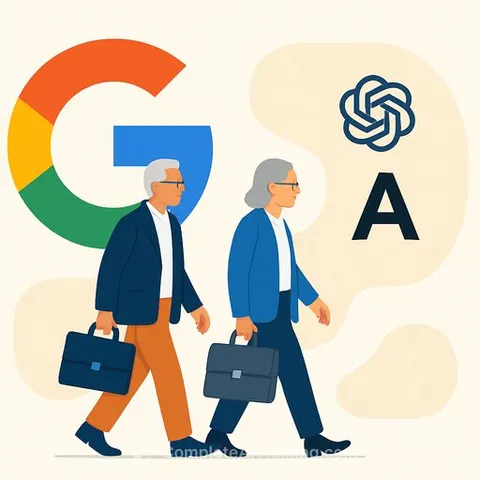
Two of Google's most prominent AI researchers announced within days of each other that they are leaving for rival labs. Noam Shazeer, a co-lead of the Gemini models, is heading to OpenAI. John Jumper, who led the AlphaFold project at Google DeepMind, is going to Anthropic. The moves land at a moment when Alphabet shares fell about 5% to 6%, with market reports tying the drop to concerns about AI spending and Google's ability to retain senior AI talent.
Shazeer announced his move on X on June 18. He co-authored the paper "Attention Is All You Need," which introduced the Transformer architecture behind most of today's large language models. Google brought him back in 2024 through a deal with Character.AI reported at $2.7 billion, then installed him as a co-lead on Gemini. He is leaving less than two years later. OpenAI CEO Sam Altman welcomed the hire on X.
Jumper said he would leave after nearly nine years, with plans to take time off before starting at Anthropic. He shared the 2024 Nobel Prize in Chemistry for AlphaFold, the system that predicts protein structures. Both Google DeepMind and Anthropic confirmed the move. Jumper's work on protein structure lines up with Anthropic's growing focus on AI for Science & Research.
The talent equation
Shazeer and Jumper worked on technology that sits under products the search industry now depends on. Shazeer's Transformer work is the basis for the models behind AI Overviews and AI Mode. Jumper's research showed what AI could do in science. Where researchers at that level choose to work can shape how investors and competitors read the frontier AI race.
That doesn't change how Gemini, AI Overviews, or AI Mode behave today. It does add a data point to how the race is being read. Reporting on the departures points to competitive pressure inside Google's AI work. Bloomberg reported that staff at DeepMind have raised concerns about the company lacking a clear product for businesses building AI coding tools, an area where Anthropic and OpenAI have gained ground.
What the researchers said
Jumper wrote on X:
"Demis Hassabis took a real chance letting me lead the AlphaFold team just six months after finishing my PhD."
Google's own leadership has acknowledged the gap. In May, CEO Sundar Pichai said Google was "a bit behind" on agentic coding and tied the gap to a lack of developer-facing products. The company paid a high price to bring Shazeer back once and could not keep him. Whether it changes how it holds onto senior researchers is the thing to watch.
The competitive landscape
Anthropic has an AI for Science event scheduled for June 30, and OpenAI has filed confidentially for an IPO. Both have been hiring from larger labs. For professionals watching the Google AI Courses ecosystem, the departures signal where top research talent is placing its bets - and which labs are building the internal conditions that senior scientists find compelling.
Why this matters for science and research professionals
Researcher mobility at this level is a market signal. When a Nobel laureate who built a system that changed structural biology chooses a younger lab over the one that incubated his work, it tells you something about how fast the center of gravity is shifting. For scientists and research leads evaluating where to build, the flow of talent toward labs with tighter product-research loops - and a clearer path from discovery to application - is worth tracking. The open question isn't whether Google still produces world-class research. It's whether the company can make staying the obvious choice for the people who produce it.