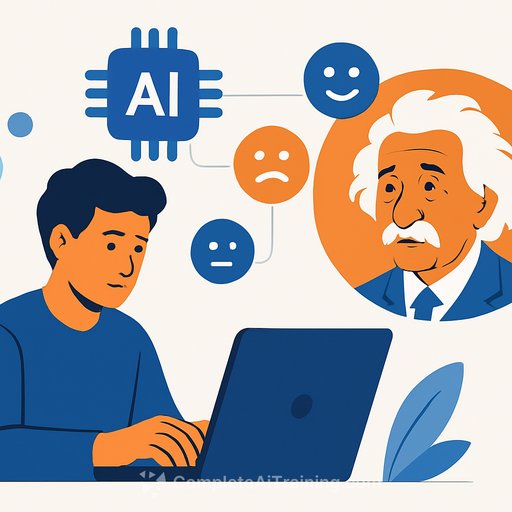
AI Meets Emotion: A Ph.D. Project Mapping the Feelings Behind Scientific Breakthroughs
Praveshika Bhandari, a computer science doctoral candidate from Nepal at the University of Arkansas at Little Rock, is using AI and natural language processing to study how emotion influences scientific work. This kind of Research connects computational methods with the study of human experience. Her case study centers on Albert Einstein. By analyzing both his private letters and formal publications, she tracks how mood and social context correlate with idea development and timing.
Her motivation is straightforward: scientific papers are polished; personal writings are candid. The contrast offers a way to see what drives problem selection, persistence, and creative leaps. With a background in both computer science and psychology, she's building a bridge between data and human experience.
The Core Question
How do emotional states and social relationships influence what scientists work on and the outcomes they achieve? Bhandari's insight is to read the public and private in tandem. The same research topic often looks clinical in journals, but personal notes show frustration, excitement, doubt, or conviction.
"Say there's a scientist and he has publications, but also has personal letters, emails and other writings," she said. "The publications are edited down to only the facts, but when the scientist talks about the same research topics in their letters, we are able to see what the scientist is feeling and where they are aiming to go with the research next."
Why Einstein?
Einstein left an extensive paper trail that spans formal science and private correspondence, alongside a life marked by migration, war, and family challenges. That combination creates a rare longitudinal dataset of thought and feeling. His letters and notes reveal how creative work continued through emotional highs and lows.
"It was really interesting to see the ways he was thinking about different things," Bhandari said. "He was still able to make all these genius contributions while having all the ups and downs of normal human life."
For context and primary sources, see The Collected Papers of Albert Einstein at Princeton University Press and the Einstein Papers Project at Caltech: Digital Einstein Papers and Einstein Papers Project.
Method: Context-Aware Emotion Modeling
Bhandari feeds AI models two parallel streams: Einstein's personal letters and his scientific writings. The system groups texts by subjects such as relativity or gravity, aligns them with life events, and tracks emotion over time. The output highlights emotional patterns (for example, rising frustration before a major paper, followed by more positive tone after publication).
The project started from an idea developed by Dr. Arya Basu during earlier work at Emory University. At UA Little Rock, he advises Bhandari alongside Dr. Jan Springer. An initial avenue-detecting suicidal ideation signals in social media-was dropped due to privacy constraints and data access. Pivoting to Einstein's public archives kept the rigor without the ethical trade-offs.
What This Means for Researchers
- Make the hidden visible: quantify how mood and social context track with problem selection, iteration cycles, and publication timing.
- Improve planning: anticipate when projects stall from emotional friction and adjust support, collaboration, or scope.
- Team health: use aggregated, consented signals to spot burnout risk early without prying into private data.
- Better retrospectives: pair bibliometrics with emotional timelines to explain why certain bets paid off.
How to Apply a Similar Approach in Your Lab
- Data collection (with consent): pair formal outputs (preprints, papers, notes) with informal reflections (lab journals, project updates). Avoid private content without explicit approval.
- Topic segmentation: cluster texts by project or concept so emotion tracks to the right workstream.
- Context tagging: align timelines with key events (grant cycles, moves, reviews, personal disruptions) to explain spikes.
- Models: start simple (lexicon or zero-shot emotion classifiers), then fine-tune transformers on a small, labeled subset.
- Validation: use inter-rater checks on a sample; rerun models after major tweaks.
- Ethics: never diagnose; keep analysis opt-in; limit access; report only aggregated patterns.
Findings So Far
Einstein's writings show emotion as a practical force, not background noise. Frustration often rises before breakthroughs; relief and optimism follow publication. The pattern suggests that emotional cycles can forecast momentum and inform when to press, pause, or change tactics.
"Emotion shapes everything we do every day in our lives," Bhandari said. "Even in science, the way you feel about a problem can shape how you approach it. Emotions matter and impact your work."
Beyond One Scientist
Bhandari is automating the pipeline so it can be applied beyond Einstein-across scientists, artists, athletes, or any creative field. She plans to expand from text to images, paintings, and handwriting to see how expression shifts across media. The work will continue after graduation.
Her aim is to study how people think-well-known figures and everyday contributors alike-and to extract lessons that help individuals and teams do better work with fewer blind spots.
Practical Next Steps
- Run a 90-day pilot in your group: collect consented journal snippets and weekly project notes; tag events; test a baseline emotion model.
- Create a simple "emotion x project" dashboard for trend-spotting, updated biweekly.
- Add a short reflection prompt to retrospectives: "What felt hard? What boosted momentum?" Compare against model outputs.
- Document guardrails: what data is in-scope, who sees it, and how long it's stored.
Ethics and Limits
The work targets patterns, not diagnoses. Therapists remain central for care, and any AI signal must be contextualized by humans. The point is to add another lens to research management, not to police feelings.
Want to Skill Up on the Tools?
If you're building similar NLP or analysis pipelines, here are two practical learning paths to consider: AI Learning Path for Training & Development Managers and AI Learning Path for Training Coordinators. Keep it practical: choose one track, run a small pilot, and iterate.
Your membership also unlocks: