
AI news ·
UAE plans to run half its government operations with AI within two years
The UAE plans to run half its government operations on agentic AI by 2028, one of the most aggressive public-sector deployments anywhere. Key questions around accountability, bias, and data privacy remain unresolved.
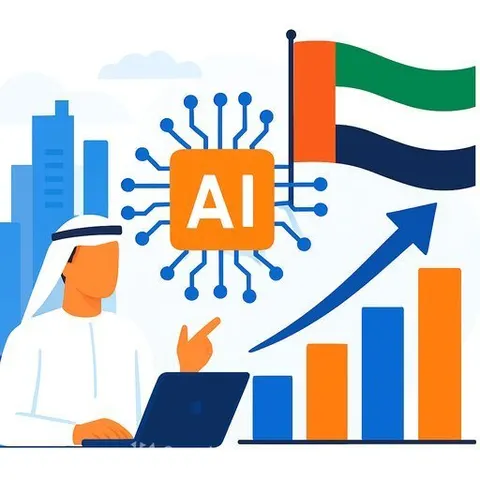
UAE Plans to Hand Half Its Government Operations to AI Within Two Years
The United Arab Emirates announced it will integrate agentic artificial intelligence across half of its government operations by 2028, marking one of the most aggressive government AI deployments globally. Most governments are still debating whether to use AI at all.
Agentic AI systems analyze information, make decisions and take action with minimal human input. Instead of suggesting what a person should do next, these systems can complete tasks from start to finish and adjust workflows in real time.
In practical terms, this means faster permit approvals, automated public services and systems that respond instantly to demand shifts. Government processes would move continuously instead of waiting for human approval.
How the rollout will work
The UAE has assigned clear leadership. Mansour bin Zayed Al Nahyan, a senior government official, will oversee the initiative. Mohammad Al Gergawi, a cabinet minister focused on government modernization, will lead day-to-day execution.
Every ministry and government entity will be evaluated on adoption speed, implementation quality and workflow redesign. The structure leaves little room for gradual approaches.
All federal employees will receive AI training. The goal is building a workforce that works alongside intelligent systems rather than competing with them. This addresses a common concern: job displacement from automation.
If successful, this workforce model could influence how other countries approach large-scale automation. If it struggles, it will expose how difficult reskilling at scale actually is.
The accountability problem
When AI systems make government decisions, responsibility becomes unclear. If something goes wrong, was it the system, the developer or the agency using it? No one has a clean answer yet.
Privacy concerns run deep. Government systems already handle sensitive personal data. Expanding AI across those systems could increase data collection, analysis and storage in ways that worry privacy experts.
Bias in AI models is another risk. If training data has gaps or flaws, outcomes reflect that. In government, biased AI could affect service access, approvals or enforcement decisions in ways people never see.
Trust remains uncertain. Even if systems work as intended, people may hesitate to accept machine-made decisions that affect their daily lives.
What this means beyond the UAE
This move raises expectations globally. When one government delivers faster services with AI, citizens elsewhere will ask why theirs cannot.
It accelerates the international AI race. Other governments will need to balance speed against privacy, security and oversight-a difficult equation.
The shift is significant because AI is moving into decision-making roles, not just support functions. This changes how systems get built and how accountability works.
The United States may see similar experiments at state and city levels, where innovation can move faster than at the federal level.
The stakes
The UAE is betting that AI can reshape how government operates. The timeline is aggressive. The scope is massive. What stands out most is how quickly this is moving from announcement to execution.
The questions are just as large. Who is accountable when AI makes a decision? How much data sits behind the scenes? How much trust will people place in systems they cannot fully understand?
This could become a model other governments adopt. It could also expose real challenges around transparency and control. Either way, AI is moving deeper into systems that affect everyday life.
For government professionals, this raises a direct question: as AI for Government operations expand, how will your role change? Understanding AI Agents & Automation is becoming essential for anyone in public service.