
AI news ·
UC San Diego publishes protocol-grounded self-triage chatbot trained on AMA medical flowcharts
UCSD engineers built a medical chatbot trained on 100 AMA clinical flowcharts to help patients decide if they need care. It recommends self-care, a scheduled visit, or emergency care-but real-world testing hasn't begun.
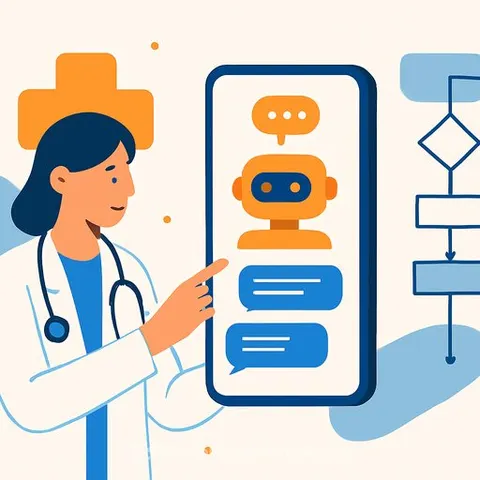
UCSD Researchers Build Medical Chatbot Anchored to Clinical Flowcharts
Engineers at the University of California San Diego published a paper in Nature Health describing a conversational AI chatbot designed to help patients assess whether they need medical care. The system is trained on 100 step-by-step medical flowcharts developed by the American Medical Association.
The design addresses a practical problem: patients increasingly turn to online searches and chatbots for symptom assessment, but those tools often lack clinical grounding. This system tethers its responses to explicit medical protocols rather than relying on unconstrained generative output.
How It Works
Three AI agents operate behind the scenes. The first identifies the patient's issue and selects the appropriate flowchart, factoring in details like age. The system then mirrors the logic of symptom-based flowcharts while adapting to back-and-forth conversation where patients describe symptoms in their own words.
The chatbot recommends one of three outcomes: self-care, scheduling a visit, or seeking emergency care.
Edward Wang, senior author on the study, said: "It can be further adapted to accommodate provider-specific protocols, which gives healthcare organizations full control over the clinical logic their patients encounter."
Yujia (Nancy) Liu, first author, said: "Our system uses these flowcharts to ground the conversation with the patient."
Why Protocol Grounding Matters
Anchoring decisions to explicit clinical flowcharts improves traceability and auditability compared with purely free-form chatbots. The trade-off is engineering work: mapping free-text patient descriptions to discrete flowchart nodes and handling ambiguous cases both require careful design.
This approach reflects a broader pattern in clinical AI research: combining structured clinical logic with conversational interfaces to balance safety, clinician oversight, and scalability.
What Remains Unclear
The paper describes a research prototype, not a deployed system. Real-world validation remains pending. Observers will watch for peer-reviewed evaluation metrics, prospective testing in actual patient populations, statements from healthcare providers about integration and workflow, and regulatory guidance tied to automated triage tools.
The researchers suggest the chatbot could reduce unnecessary hospital visits and help people who need care seek it sooner, but those outcomes have not been documented at deployment scale.
For practitioners working on clinical-facing conversational systems, this work demonstrates how protocol grounding can constrain AI output to clinically defensible decisions. The next phase is real-world testing and provider adoption.
Learn more about Generative AI and LLM applications or explore AI for Healthcare to deepen your understanding of these systems.