University of Florida researchers use AI and digital twins to reduce airport delays
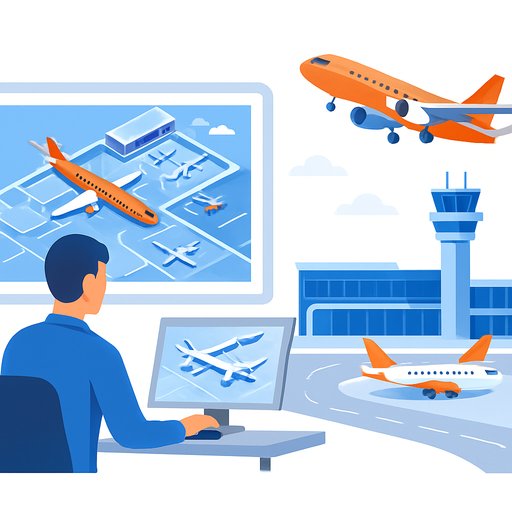
University of Florida engineers are building digital simulations of Dallas Fort Worth International Airport to test how AI can prevent cascading failures that ripple through airport operations. The National Science Foundation-funded project models flights, passengers, baggage handling and security checkpoints to identify bottlenecks before they disrupt real travelers.
The Strategic Partnerships for Enhancing Airport Resilience (SPEAR) study applies biological engineering techniques-tools normally used to predict animal migration patterns and watershed behavior-to airport logistics. A small mechanical failure, a late-arriving flight or a sudden thunderstorm can trigger chain reactions that strand passengers and create hours of delays, said Henry Medeiros, an associate professor in the Department of Agricultural and Biological Engineering.
The research team simulates how external shocks affect airport systems. Cyber attacks, heat waves, blizzards and communication failures all require rapid operational adjustments. By modeling these scenarios in a digital environment, researchers can design systems that anticipate problems rather than react to them.
Dallas Fort Worth International Airport handles about 86 million passengers annually, making it an ideal testing ground for understanding how small disruptions cascade through complex systems.
Building resilience into airport design
The goal extends beyond preventing problems. Greg Kiker, chair of the Department of Agricultural and Biological Engineering, said the research focuses on how airports recover after disruptions occur. "To bounce back, you have to understand your systems. You have to build stronger systems, and you have to build in recovery," he said.
The research balances three competing priorities: safety, efficiency and customer experience. Safety remains non-negotiable, but airports must also move people smoothly without compromising service quality.
Biological engineers bring a different perspective to airport management. They regularly work with systems that appear chaotic-weather patterns, ecosystem dynamics, crop production-but can be predicted and managed with the right framework. That expertise translates directly to managing the unpredictable flows of people, baggage and aircraft.
The research team includes five faculty members from the Department of Agricultural and Biological Engineering: Medeiros, Kiker, Ziynet Boz, Rafael Muñoz-Carpena and Nargiza Ludgate.
For professionals working in operations research or systems engineering, understanding how digital twins and AI research apply to complex logistics problems offers practical insights into AI agents and automation in real-world settings.
Your membership also unlocks: