
AI news ·
Union Catholic teacher Marla James publishes book on AI in education
Dr. Marla James, the 2024 NJ Teacher of the Year, published a book on documented learning. Her framework requires students to show their reasoning, not just final products.
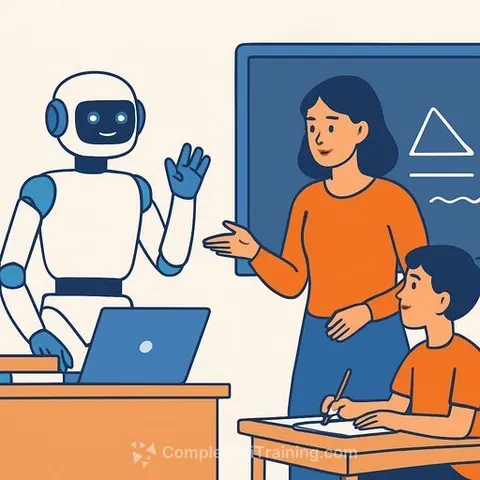
Union Catholic High School faculty member Dr. Marla James has published Documented Learning: Process over Product in the Age of AI, a book that gives K-12 and higher education teachers a practical way to embrace artificial intelligence while keeping authentic student learning visible. The book arrives as AI tools can instantly generate essays, solve math problems, and complete assignments, forcing schools to rethink how they assess what students actually know and can do.
James, who was named the 2024 Co-Non-Public School Teacher of the Year by the New Jersey Council for American Private Education, spent years researching the question that drives the book: "How do we know what students are actually learning when AI can generate essays and complete other student assignments in seconds?" Her answer is a framework she calls documented learning. The book is part of a broader conversation about AI for Education that is reshaping classrooms across the country.
Shifting from product to process
Rather than policing AI use, James argues that schools should make the learning journey visible. "Documented learning is the intentional practice of making learning visible," she said. "Instead of submitting only a finished product, students document the journey. This can include how they brainstormed, conducted research, evaluated evidence, collaborated with AI, questioned AI output, made revisions, and reflected on their decisions."
James became frustrated with the rush toward AI detection tools. "I also encountered too many proposed solutions that focused almost entirely on catching students using AI instead of redesigning learning for a world where AI already exists," she said. "That felt backwards." She does not support plagiarism detectors, calling them fallible and damaging to teacher-student trust. Instead, she recommends requiring students to submit research logs, revision histories, AI-use logs, reflection journals, annotated AI conversations, video explanations, and oral presentations alongside final work.
Practical documentation strategies
The book details several strategies that capture student thinking while it happens. AI-use logs, reflection journals, annotated drafts, and video portfolios all make the reasoning behind a final product transparent. "Reflection journals encourage metacognition," James said. "Students need to be taught how to think about their learning and knowledge acquisition. Video portfolios give students the opportunity to explain ideas and how they arrived at them in their own voices."
These artifacts shift the teacher's role from detective to guide. James said the goal is not to prove a student didn't use AI, but "to understand how they used it, where they challenged it, where they improved upon it, and ultimately what they learned."
Starting small and building AI literacy
For educators overwhelmed by the pace of AI development, James offered a simple starting point. "Start small," she said. "You don't need to redesign your entire curriculum. Choose one assignment and ask students to submit one additional artifact that reveals their thinking." That artifact could be a reflection, a planning document, a revision log, or an annotated draft.
James believes that AI literacy will become essential, but only when paired with critical thinking, ethical decision-making, creativity, communication, adaptability, and information literacy. "The future lies with individuals who have the capacity to work with AI without being overly reliant on it," she said. Schools can build these skills by giving students real-world problems, requiring rationales for solutions, encouraging productive AI collaboration, and incorporating regular reflective exercises.
Her work at Union Catholic, where she contributed to the school's Responsible AI in Learning initiative that earned a RAIL Endorsement from the Middle States Association, informed many of the strategies in the book.
Why this matters for educators
James's framework offers a direct response to the anxiety many teachers feel about AI. Instead of fighting the technology, she asks teachers to redesign assignments so that the thinking process cannot be hidden. One concrete step is to adopt a documented learning approach in a single unit this semester, requiring students to submit a reflection or revision log alongside the final product. For teachers ready to build their own AI skills, the AI Learning Path for Teachers provides structured guidance on integrating AI ethically and effectively into classroom practice.
"AI has transformed what our students can do, but it has not altered what learning is," James said. "By exposing the process of learning, we do more than defend academic honesty; we foster curiosity, perseverance, reflection, and comprehension."