
AI news ·
United States and China pursue divergent state investment strategies for artificial intelligence sovereignty
The U.S. and China are pursuing divergent state AI investment models. Beijing allocated $8.2 billion to integrate domestic tech into its industrial plan.
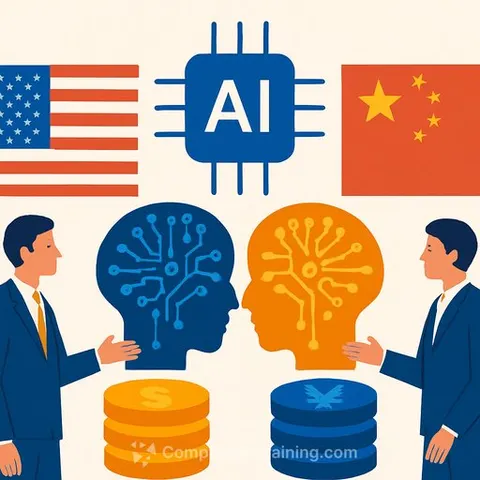
The Trump administration has held discussions with OpenAI and other major AI labs about acquiring an equity stake before they go public, while China's state-backed National Artificial Intelligence Industry Investment Fund is finalizing talks to invest in DeepSeek's first outside funding round. The parallel moves reflect a global race to secure AI sovereignty, but the two nations are pursuing starkly different strategies.
A bipartisan push for a U.S. sovereign fund
In the United States, an unusual political coalition is forming. President Donald Trump and Senator Bernie Sanders have both expressed support for a public or sovereign wealth fund that would allow ordinary citizens to share in the wealth generated by AI. Sanders announced in June 2026 that he would introduce the "American AI Sovereign Wealth Fund Act." OpenAI and Anthropic have endorsed similar ideas.
However, a government stake in an AI lab creates clear conflicts of interest. Regulators might hesitate to intervene on safety, antitrust, or content moderation if the government owns part of the company. The arrangement could also produce AI firms considered "too big to fail." OpenAI's CFO Sarah Friar sparked controversy last year when she suggested a federal "backstop" to finance computing infrastructure for the firm's development.
Critics cite China's experience with state-backed semiconductor funds, which were plagued by inefficiency, corruption, and waste. But that argument misses a shift in China's innovation strategy, according to researchers who have studied Beijing's approach.
How China's "platform state capitalism" works
China's government now manages its innovation ecosystem in a manner similar to a large digital platform. It uses subsidies and incentives to attract firms, applies regulation to manage interactions, and imposes strict exit controls to protect its competitive advantages. State investments follow the same logic, treating AI firms not as standalone champions but as components of a tightly coordinated supply chain.
China's national AI fund, launched in early 2025 with CN¥60 billion ($8.2 billion) in initial capital from the third phase of the government's semiconductor fund, targets self-sufficiency across the entire AI ecosystem. It invests in everything from chip design to AI applications. The planned investment in DeepSeek is part of this platform governance: by funding a key complementor, the state can align product development with broader strategic goals.
DeepSeek's latest V4 models are reportedly adapted to run on Huawei's Ascend chips, China's best domestic alternative to Nvidia. That collaboration stimulates demand for homegrown hardware and encourages developers to build around China's AI infrastructure. The investment is not just about backing a winner; it is about shaping the whole stack.
A clash of capital models
U.S. policymakers debating whether and how to invest in leading AI firms should pay close attention to the Chinese model. While American discussions have focused on a public stake as a way to share AI's financial returns, China's approach uses state capital to integrate firms into a broader industrial plan. The risk for the U.S., some analysts argue, is that it embraces an old-fashioned version of state capitalism just as China moves toward a more sophisticated one.
Policy makers navigating this debate may benefit from an AI Learning Path for Policy Makers to better understand the governance and strategic dimensions of artificial intelligence.
Why this matters for government professionals
For officials shaping AI policy, the parallel moves illustrate two very different theories of state involvement. The U.S. model risks creating conflicts of interest and moral hazard, while China's platform approach aims to lock in strategic alignment across the entire AI supply chain. Understanding this distinction is critical for crafting industrial policy that preserves competitive advantage without undermining regulatory independence.