
AI news ·
United States suspension of Anthropic AI models exposes African technology dependency
A 3-week US ban on Anthropic's AI models exposed African nations' vulnerability to sudden tech shutdowns. Officials must negotiate collectively to secure future access.
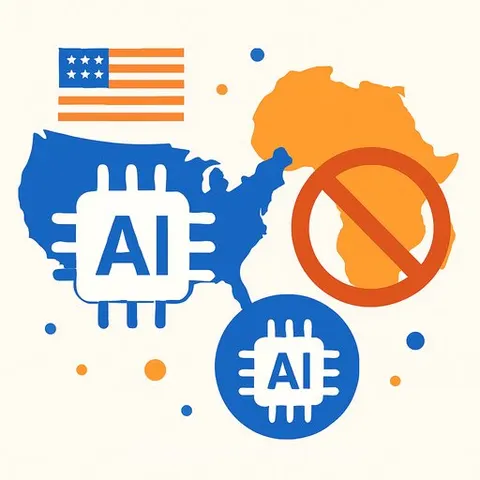
On Friday, June 12, at 5:21 p.m. ET, the US government directed artificial intelligence firm Anthropic to suspend access to its most capable AI models-Fable 5 and Mythos 5-for any foreign national, including the company's own staff. The order came with no advance notice and no timeline for restoration. The suspension, lifted on July 1, exposed how quickly a foreign government can sever access to frontier AI capability, a lesson with direct consequences for African governments that depend on US-built infrastructure.
A short-lived order with lasting implications
Fable 5 had been public for barely a week, and Mythos 5 was accessible only to a small circle of partners under Anthropic's Project Glasswing. Few institutions had built operational dependence on the models. Still, the three-week shutdown revealed the vulnerability of relying on technology controlled by a single government.
The official reason for the suspension was national security. The government said it became aware of a jailbreak technique that could bypass Fable 5's safety controls. Anthropic disputed the severity, calling the finding a "misunderstanding" and warning that applying the same standard across the industry would halt frontier model release.
The dispute did not occur in isolation. Weeks earlier, Anthropic had refused Pentagon contract terms that would have allowed the military to use its models for any lawful purpose, including autonomous weapons and domestic surveillance. After negotiations collapsed, the US Department of Defense designated Anthropic a "supply chain risk to national security." The label, historically reserved for foreign adversaries, was applied for the first time to a US company. Anthropic is contesting the designation in federal court. The export control directive arrived in an already adversarial relationship.
The dependency pattern
African governments were not part of the decision. They read the news three days later, alongside everyone else. Yet the pattern is not new. In the 1990s, the US government classified strong encryption as a munition under the Arms Export Control Act, creating a two-tiered world where foreign customers received deliberately weakened security products. The EU secured liberalization for its members by acting as a bloc. African states were residual beneficiaries, not architects of that outcome.
The directive was consistent with the US AI Action Plan, which directs federal agencies to evaluate national security risks in frontier models. The suspension lifted for everyone at once, but if that evaluation mandate hardens into a standing export-control regime, a two-tier model-full capability domestically, a weaker version abroad-becomes a real possibility for the next case.
Most of the world depends on US cloud and AI infrastructure. What sets African institutions apart is a deeper structural gap: limited capital, thin domestic research capacity, and almost no AI infrastructure of their own to fall back on or bargain with. The Malabo Convention, the African Union's cybersecurity and data protection instrument, entered into force in June 2023 but was not designed for a scenario where a foreign government terminates access to critical technology with a few hours' notice.
Four paths to reduce exposure
There is no silver bullet, but at least four partial mitigation strategies are on the table.
Local infrastructure. Requiring frontier AI companies to establish regional headquarters and host inference capacity locally can reduce latency-driven dependency and signal investment. However, US export control jurisdiction generally attaches to the technology and the company, not the server's physical location. A sufficiently broad directive can reach a US parent company's locally hosted infrastructure regardless of where the hardware sits. Localization also raises the barrier to market entry, potentially slowing access to beneficial AI applications in health, agriculture, and finance.
Diversifying away from US providers. China's Global AI Governance Initiative courts the Global South directly, and Chinese firms already occupy parts of the AI stack in several African countries at lower cost. The trade-off: Chinese models carry their own governance risks, including content controls aligned with state interests and past allegations of backdoored infrastructure. This option does not escape foreign dependency; it offers a choice between two foreign dependencies.
Continental AI development. Through AU coordination, research partnerships, and shared compute infrastructure, African countries could reduce long-term dependency. The AU's Continental AI Strategy (2024) and the African Declaration on Artificial Intelligence, endorsed by fifty-four states in April 2025, both name infrastructure and compute as priorities. The AI for Africa Initiative, launched with the 2025 South African G20 presidency, adds a mechanism for financing and technical support. The trade-off is timeline. Capacity built this way could take five to ten years, while access decisions are being made now.
Collective negotiation. African governments negotiating as a bloc through the AU or subregional bodies could drive formal inclusion in access restoration discussions. The African Continental Free Trade Area provides a credible existing framework for a collective position. The trade-off is institutional speed, but this is the only lever that operates on the same timeline as the problem.
Why this matters for Government
The June suspension was not targeted at Africa, but it showed that a single government can flip the switch on frontier AI access without warning. For African governments, the lesson is clear: the current model of bilateral negotiation with the US and tech companies leaves each country negotiating from weakness and accepting terms that do not build collective resilience. The EU's experience in the crypto wars shows that acting as a bloc creates the pressure needed to secure a seat at the table.
Policy makers now face a sequencing problem. Local infrastructure takes years to build, and sovereign AI capacity may take a decade. The most urgent step is to begin negotiating collectively through the AU for a formal voice in future access decisions. Building internal expertise is equally critical. For policy makers, understanding AI governance is no longer optional. Specialized training, such as an AI Learning Path for Policy Makers, can provide the foundation needed to anticipate and respond to such disruptions. Government officials can find additional resources on AI for Government to stay informed on policy developments and infrastructure risks.