
AI news ·
Universities face their calculator moment with AI, says humanities dean
Universities are rethinking how they assess learning as AI tools let students produce polished essays in minutes. The bigger issue isn't cheating-it's that existing assessment methods were already poor measures of actual thinking.
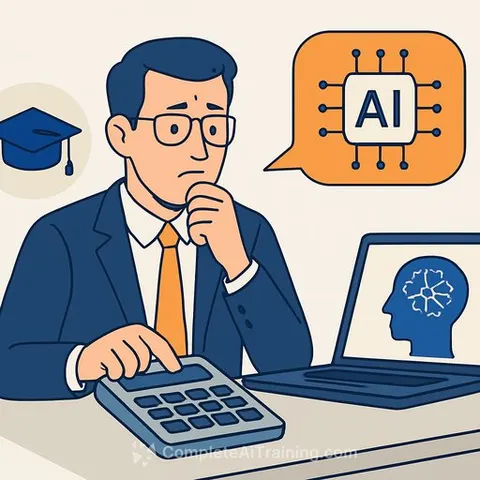
Universities face fundamental rethinking of learning in the age of generative AI
Universities are confronting a moment similar to the 1970s introduction of pocket calculators - a technology that performs core academic tasks faster and more accurately than humans ever could.
The parallel offers a useful lens. When calculators arrived, educators feared arithmetic instruction would become obsolete. Instead, something different happened: the technology clarified what actually mattered. Students still needed number sense, judgment, and the ability to recognize when an answer was wrong.
Generative AI presents universities with a comparable inflection point, though the stakes feel higher because the technology touches nearly everything higher education does.
The speed and scale of AI adoption in universities
ChatGPT reached 100 million users in two months. By 2025, over a billion people globally were using AI tools. Universities became one of the primary testing grounds almost immediately, which makes sense: large language models excel at the core activities that define higher education - reading, writing, summarizing, synthesizing, and generating arguments.
This creates genuine opportunity. For decades, education researchers have documented what Benjamin Bloom called the "2 sigma problem": students receiving one-to-one tutoring perform roughly two standard deviations better than those in conventional classrooms. The barrier was always cost.
AI makes it possible for universities to offer something previously unaffordable at scale: a 24/7 tutor available to every student, capable of adapting explanations, scaffolding learning, generating practice activities, and providing immediate feedback.
The assessment problem AI exposes
But the technology also destabilizes foundational assumptions universities have relied on for centuries, particularly around assessment and intellectual development.
Take the university essay. For generations, essays functioned as evidence of thinking - a window into how a student reasoned through material. Now students can produce polished assignments in minutes without necessarily understanding the content.
Many institutions are framing this as an academic integrity problem to be solved through detection and prohibition. That approach misses what AI actually reveals: weaknesses that already existed in how universities assess learning.
Essays were never simply about producing text. They were meant to develop reasoning, synthesis, judgment, and sustained intellectual engagement. If AI can now generate the product, universities need to refocus on the process.
What needs to change
Effective responses involve redesigning assessment around what matters:
- Make thinking more visible through interim work and explanation
- Value iteration and reflection, not just final products
- Assess judgment and application rather than knowledge retrieval
- Combine supervised and unsupervised forms of assessment
- Teach students to use AI critically instead of pretending it doesn't exist
This is not about abandoning standards. It's about redefining what rigorous learning looks like when AI tools are available to students.
The human side of the equation
The larger challenge may be cultural rather than technical. Universities need to avoid two extremes: the belief that AI will solve education, and the fear that it will destroy it.
AI will likely prove enormously powerful in structured domains where feedback is clear and knowledge can be scaffolded systematically. But education is also profoundly human. Motivation, trust, identity, mentorship, belonging, and social interaction are not incidental features of university life - they are central to learning itself.
The future university will not simply be "AI-powered." It will be defined by how successfully it combines technological capability with human judgment.
Institutions that thrive will not necessarily be those with the largest AI budgets or fastest adoption cycles. They will be the ones that remain clear about what universities actually exist to do.
Educational technologies do not determine outcomes. People and institutions do.
For more on how AI is changing education, see our coverage of AI for Education and Generative AI and LLM.