
AI news ·
Universities redesign teaching and evaluation methods in response to generative AI
Universities are redesigning assessments to demand critical thinking as AI lets students outsource mental effort. Schools must now evaluate reasoning, not just grade outputs.
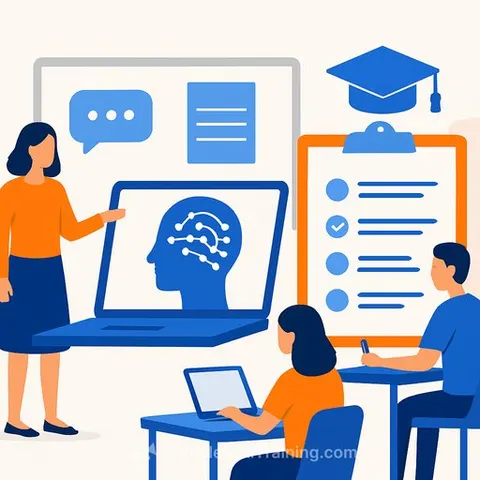
Generative AI is fundamentally changing what it means to learn. Earlier internet tools helped students locate information. AI now produces coherent essays, summaries, and arguments that mimic understanding itself. The challenge facing universities is no longer access - it's whether students are outsourcing the mental effort required to build real knowledge.
Cognitive neuroscientist Stanislas Dehaene, in his book How We Learn, said durable learning requires "attention, active engagement, error correction, and sustained mental effort." His research underscores that comprehension develops not when answers are instantly available, but when learners wrestle with ambiguity, make mistakes, and refine their thinking.
Outsourcing intellectual effort on campus
Student behavior is shifting visibly. AI tools are used not just for writing help, but for brainstorming, coding support, summarisation, interview practice, and reflective writing. Faculty, meanwhile, are redesigning assignments and rethinking evaluation methods. In India, where the higher education system is among the largest and most diverse, AI-assisted tools may broaden access for students from varied linguistic and academic backgrounds.
The risks run deeper than academic misconduct. When every difficulty is resolved by a polished AI response, students can lose the patience required for deep intellectual engagement. The danger is not simply misinformation or plagiarism, but the gradual outsourcing of intellectual effort. Unlike search engines that forced students to compare sources and structure arguments, AI now performs many of those cognitive tasks itself.
Redesigning teaching and assessment
Universities worldwide are rethinking both pedagogy and evaluation. In parts of the Indian system that still emphasize information transmission and reproduction, the cracks are becoming clear. Faculty members report that written submissions are more coherent than ever, yet classroom discussions don't always reflect the same depth. Assignments built around reproducing information no longer work reliably.
This shift is pushing classrooms toward discussion-led learning, applied problem-solving, and assessments that ask students to explain how they arrived at an answer. Paradoxically, AI is exposing long-standing weaknesses - excessive reliance on rote memorization and formulaic testing - that educators have criticized for years. The pressure is now forcing institutions toward inquiry-driven and experiential models, though the transition demands significant investment in faculty development.
What makes graduates employable now
As AI automates routine analytical work, employability will depend less on producing information and more on interpreting context, exercising judgment, and asking meaningful questions. Technical competence remains necessary but no longer sufficient. AI fluency is becoming essential across disciplines - not just for engineers, but for management, law, and social science graduates.
For India, this is both opportunity and urgency. The country has one of the youngest populations and largest education systems, yet curriculum revision cycles and faculty preparedness often lag behind technological change. Bridging the gap will require more dynamic curriculum redesign, stronger industry ties, and sustained investment in training.
Faster research, harder questions
Research is among the areas most transformed. Academic work depends on synthesis, interpretation, and articulation - tasks AI performs increasingly well. Researchers routinely use AI for literature reviews, language refinement, and data analysis. These tools improve efficiency, but they also raise difficult questions about authorship, originality, and what scholarship means.
Universities will need clear ethical frameworks for AI in academic work. The bigger challenge is preserving the intellectual discipline that produces original research, not just detecting misuse.
Institutions that succeed won't be the fastest technology adopters. They will be the ones that integrate AI while defending the cognitive effort real learning demands. AI makes understanding look effortless. In that world, the responsibility of universities becomes even greater - ensuring students develop the habits of thinking that lead to meaningful learning.
Why this matters for education professionals
For educators, the immediate priority is to redesign assessment away from tasks AI can complete and toward demonstrations of critical thinking, contextual judgment, and the ability to articulate reasoning. Faculty development programs must equip instructors to foster inquiry-driven learning in AI-present classrooms. The value of a degree will increasingly be measured not by the answers students can produce, but by the questions they learn to ask.