
AI news ·
University of Hawaiʻi receives $12 million NIH grant to establish Pacific AI and data science center for medicine
The University of Hawaiʻi Cancer Center and medical school landed over $12 million from the NIH to launch an AI-driven biomedical research center. The center aims to convert that into roughly $19.5 million more in independent federal grants, pushing the total impact past $31 million.
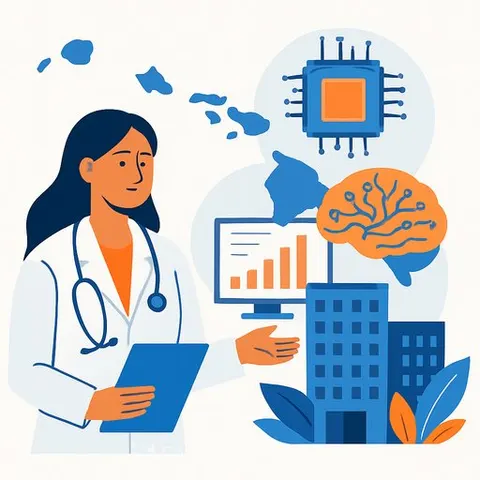
The University of Hawaiʻi Cancer Center and the John A. Burns School of Medicine have secured more than $12 million from the National Institutes of Health to launch a new research center that will apply artificial intelligence to biomedical challenges in Hawaiʻi and the Pacific. The five-year award, administered through the NIH's Centers of Biomedical Research Excellence program, funds the Pacific Center for Artificial Intelligence and Data Science in Medicine, or PAC-AID, through February 2031.
The center will be led by principal investigators John Shepherd, chief scientific officer at the UH Cancer Center, and Youping Deng, co-director of the Genomics and Bioinformatics Shared Resource at the UH Cancer Center. It will operate from the shared Kakaʻako campus, physically housed within both institutions.
What PAC-AID will build
The award funds the renovation of the UH Cancer Center Data Center to create a Medical AI Core, or MedAI Core. That facility will provide high-performance computing resources and AI expertise to investigators across disciplines. PAC-AID will directly fund four inaugural research projects and establish a Pilot Projects Program that supports more than eight locally relevant pilot studies.
"AI has the potential to unlock major medical breakthroughs and help people live healthier lives, and we need to take advantage of it," said U.S. Sen. Brian Schatz, who helped secure the grant. "This new funding will help Hawaiʻi continue to attract top-tier talent and develop treatments and cures that will benefit people across the state."
Initial funded projects span several research areas. UH Cancer Center researcher Kevin Cassel will use full-body imaging to triage skin lesions. Elizabeth Nakasone, also at the Cancer Center, will study pancreatic cancer in Native Hawaiian and Japanese populations. Public health researcher Jonathan Huang will model how environmental toxicants affect fetal development, and JABSOM's Yiqiang Zhang will identify genetic traits linked to congenital heart disease.
Workforce and economic targets
Shepherd and Deng will direct efforts to build research capacity and develop early-stage faculty investigators. The center is designed to support six to eight faculty members across UH and Pacific Island institutions who will use AI and data science to address cancer and chronic disease outcomes in medically underserved populations. These techniques are central to the growing field of AI for Science & Research.
Shepherd outlined a clear financial benchmark. The initial four funded projects, plus two to four more when those graduate in year three, are expected to later achieve independent NIH R01 funding at roughly $3.25 million per award. That would represent an additional $19.5 million in federal research funding returned to Hawaiʻi, on top of the $12 million COBRE award - a combined potential economic and research impact of more than $31 million over the first five-year period.
"This COBRE award provides the critical infrastructure to bridge advanced AI computational methods with our specific clinical and community health challenges," Shepherd said. "By fostering a collaborative environment for our investigators, we are equipping them with the technical capabilities to tackle the most persistent health disparities in our islands and turn complex data into actionable health solutions."
Integrating AI into medical research
Shepherd already leads the Hawaiʻi and Pacific Islands Mammography Registry, where he uses a large breast imaging database to develop AI biomarkers that predict cancer risk for Asian and Pacific Islander populations. The new center extends that approach across multiple disease areas, applying AI for Healthcare to improve diagnosis, prevention, and treatment.
"By the end of this project, we expect to have a nationally competitive Medical AI Core, four independently funded research leaders, and more than 10 pilot projects," Deng said. "Through these efforts, alongside workshops and collaborative research opportunities, we will significantly strengthen Hawaiʻi's capacity for AI-enabled biomedical research and innovation."
UH Cancer Center Director Naoto T. Ueno said the $12 million will strengthen AI and data science capabilities while supporting the next generation of investigators. JABSOM Dean Sam Shomaker added that the investment will help accelerate discoveries that address real health challenges facing local communities.
Why this matters for science and research professionals
PAC-AID is structured as a COBRE Phase 1 center, which follows a 15-year development cycle focused on building independent biomedical researchers and sustainable research infrastructure. For scientists and research administrators, the model is worth watching: it ties infrastructure investment directly to faculty development milestones, with a stated goal of converting early-stage investigators into independently funded R01 grant recipients. The projected return - $19.5 million in follow-on funding against a $12 million initial award - offers a concrete case study in how institutional AI capabilities can be built to generate sustained federal research funding, not just one-time project grants.