
AI news ·
Unmanaged mobile AI use exposes enterprises to security and compliance risks
93% of U.S. employees use mobile devices, yet corporate AI security remains stuck in desktop-era models. This gap risks data leaks and regulatory fines.
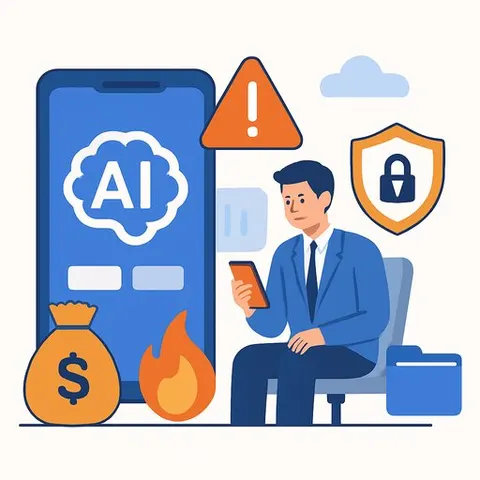
In the U.S., 93% of employees now spend at least a third of their time away from a desk, using mobile devices as the primary interface for work email, messaging, and cloud apps. Yet while organizations rush to adopt AI for productivity, their governance models-the policies and systems that monitor and secure data-remain anchored in desktop-era thinking. This disconnect creates a growing blind spot that traditional IT security teams are not equipped to see.
The rise of autonomous agents
Centralized security checkpoints like firewalls once acted as digital guards, inspecting every piece of data leaving the office network. Today, mobile devices and cloud apps route traffic entirely around those checkpoints, making a large share of AI activity invisible to corporate oversight. An employee might snap a photo of a confidential whiteboard strategy, upload it to a free mobile AI assistant to generate a summary, and expose intellectual property without any security alert.
The risk deepens as agentic AI enters the enterprise. Gartner describes agentic systems as "autonomous actors" that plan, decide, and execute multi-step workflows independently. More than 40% of enterprise applications will include task-specific AI agents this year, according to Gartner's strategic technology trend forecasts. These systems can initiate communications, trigger financial transactions, and modify records without human review.
When embedded in mobile environments, agentic AI operates with full user authority-using corporate access, authenticated sessions, and third-party cloud accounts linked to the organization. A phone consolidates identity, access, and data into a single always-on interface, making it the ideal launch point for autonomous action. A single gap on a mobile device can enable data theft, privileged API access, and manipulation of business processes at machine speed, beyond the reach of desktop-centric controls. This shift falls squarely into the domain of AI Agents & Automation, where autonomous systems demand new oversight strategies.
Compliance is no longer a choice
For executive leadership, compliance is now a regulatory mandate. The EU AI Act, ISO/IEC 42001, and the NIST AI Risk Management Framework all require complete visibility, control, and traceability across AI usage-including activity on mobile devices. Organizations must be able to follow the full lineage of data from origin to destination. A company that overlooks the mobile dimension can appear compliant on paper while remaining exposed on the devices employees use daily. Small gaps compound into material regulatory and legal risk, leaving enterprises vulnerable to non-compliance and data protection failures.
Understanding these frameworks is a key part of AI for Executives & Strategy, as leaders must align governance with the mobile-first reality of their workforce.
New approaches to mobile AI governance
Modern solutions address this by continuously monitoring mobile AI activity while preserving employee privacy. A privacy-by-design model on personal devices ignores private apps and personal browsing, triggering an audit log only when corporate data interacts with an AI tool. The result is a tamper-proof, audit-ready record showing, for example, that an encrypted corporate document was blocked from upload to an unapproved public LLM. Compliance regulators get the exact proof of data protection they require, while the employee's personal life remains entirely private.
Lightweight guardrails operating directly on the mobile device can also intercept risky actions in real time. If an employee attempts to copy sensitive financial figures from a corporate app into an unauthorized AI chatbot, the system blocks the transfer at the screen layer and suggests an approved enterprise alternative. In the background, the same solution catalogs hidden AI software libraries embedded within downloaded apps and automatically cuts off an app's access to corporate cloud accounts if it detects an autonomous AI agent attempting to harvest data over a cellular connection.
Why this matters for executives and strategy
Banning AI or restricting mobile access is impractical and stifles innovation. The real imperative is to modernize governance so that it extends visibility into the mobile devices where work actually happens. The greatest threat in an AI-powered enterprise is not the technology itself, but the governance gap that leaves mobile AI unseen and unmanaged. Executives who close that gap can enforce compliance, protect intellectual property, and allow AI adoption to scale safely-without freezing innovation or invading employee privacy.