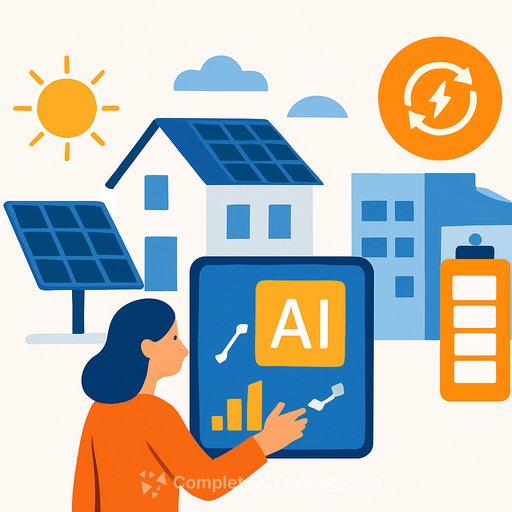
AI-enabled energy management: what managers need to know
UNSW researchers are partnering with Sydney-based installer Aussie Solar Batteries Group to build and test AI-driven platforms that coordinate solar and battery systems across homes and businesses. The project aims to stabilise the grid, lower operational costs, and increase returns from distributed energy resources (DERs) by trialling the technology under real operating conditions.
The collaboration will focus on forecasting, demand-side management, optimisation algorithms, and digital-twin modelling to improve virtual power plant (VPP) deployment. In plain terms: smarter software deciding when to charge, discharge, store, or send energy-across thousands of sites-so the whole network runs cleaner and cheaper.
Why this matters for management
This is a credible path from lab to field. UNSW brings AI and energy systems expertise; Aussie Solar Batteries brings on-the-ground deployment at scale. Together, they're building tools that help asset owners reduce energy bills, increase VPP revenue, and support reliability-without adding operational complexity for customers.
Aussie Solar Batteries CEO Steven Yu framed it simply: pair proven research with real installation capacity so households and businesses get systems that can learn, adapt, and cut costs without constant oversight.
How the project will work
- AI forecasting: Predict solar generation and demand at site and fleet levels to make better dispatch decisions.
- Demand-side management: Shift and shape loads to align with tariffs, network constraints, and market signals.
- Optimisation algorithms: Orchestrate charging/discharging across many batteries to maximise overall value, not just site-by-site outcomes.
- Digital twins: Simulate behaviour of DER fleets to test strategies safely before they go live.
Commercialisation and policy context
The work sits under the Australian government's Trailblazer for Recycling and Clean Energy (TRaCE) initiative, led by UNSW with the University of Newcastle. Both parties will operate within TRaCE's framework to prepare pathways to market, aligned with Commonwealth funding rules that keep benefits in Australia.
The project runs through the end of 2026, giving time for field trials, algorithm tuning, and integration with retailers, networks, and market operators.
What to watch and measure as a manager
- Business case: Model stacked value-bill savings, demand charge reduction, VPP incentives, and potential network services. Track simple payback and IRR at site and portfolio levels.
- Risk and control: Ensure algorithms respect site constraints (comfort, operations, critical equipment). Confirm fail-safes and revert-to-safe modes.
- Interoperability: Check compatibility across inverters, batteries, metering, and retailer/VPP platforms. Open standards reduce lock-in.
- Data governance: Clarify data ownership, access, latency, and retention. Review cybersecurity and privacy obligations early.
- Tariff alignment: Optimisation must map to your tariffs and demand windows. Small mismatches can erase savings.
- Change management: Train facilities teams and communicate with tenants or site managers. Clear SOPs avoid overrides that break the model.
Practical next steps
- Identify 1-3 pilot sites with different load profiles (office, light industrial, retail) and define clear KPIs: bill reduction %, demand charge reduction, VPP revenue per kW, and uptime.
- Run a digital-twin simulation before hardware upgrades. Validate results against 6-12 months of historical interval data.
- Negotiate performance-based terms with your VPP/installer partner (e.g., shared upside or minimum performance guarantees).
- Set governance: monthly performance reviews, exception reporting, and a playbook for tariff or market changes.
- Plan for scale: standardise metering, communications, and cybersecurity so pilots can roll into a portfolio deployment.
Key risks to manage
- Overfitting: Algorithms that perform well in trials but fail under new tariffs or atypical weather. Mitigate with rolling validation and guardrails.
- Revenue volatility: VPP earnings vary with market conditions. Use conservative assumptions and stress tests.
- Vendor lock-in: Proprietary controls can limit future options. Prioritise open APIs and data portability.
- Operational disruption: Poor coordination can affect comfort or business processes. Mandate site-level constraints and overrides with audit trails.
Timeline and signals to watch
Through 2026, expect iterative releases: improved forecasting accuracy, broader hardware support, and tighter market integration. Watch for published field results, interoperability certifications, and retailer/network partnerships that simplify onboarding.
Learn more
Bottom line: AI-coordinated solar and batteries are moving from pilots to practical deployment. If you manage assets with material energy spend, now is the time to set up pilots, lock in data and governance, and position your portfolio to capture value as VPPs scale.
Your membership also unlocks: