
AI news ·
U.S. chip controls fail to slow China's AI development, analyst argues for global safety pact
U.S. chip export controls have failed to slow China's A.I. development, as Chinese firms rent computing power abroad and copy American models through distillation. Experts now argue the U.S. should pursue a global A.I. safety agreement instead.
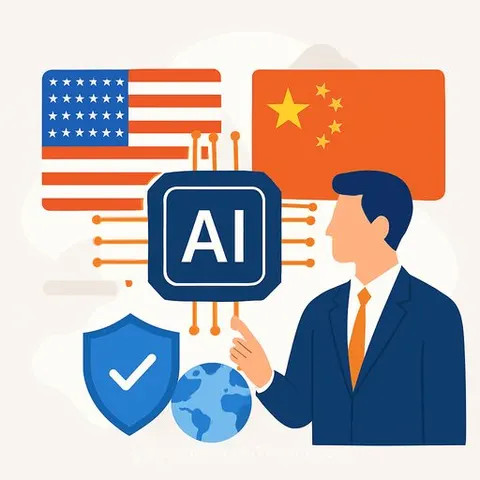
U.S. Chip Restrictions Aren't Stopping China's A.I. Development
The Biden administration's 2022 strategy to block China from advanced semiconductors has failed. China's technology sector has found multiple ways around export controls, making the restrictions ineffective at slowing A.I. development. Rather than pursuing an unwinnable containment strategy, the U.S. should negotiate a global safety agreement with China on generative AI and large language models.
How China Circumvented the Controls
The original premise seemed sound: premium A.I. chips are the size of skateboards and require hands-on engineering support from chipmakers, making them difficult to smuggle or deploy without detection. China found a workaround within months.
Chinese developers began training their A.I. models on chips located outside China's borders. They rent computing capacity at data centers in Southeast Asian countries, concealing the Chinese origin of their models. This simple shift eliminated the advantage the U.S. thought it had secured.
China is also learning to work without the most advanced chips by stacking less powerful ones together. When U.S. labs release new models, Chinese competitors quickly reverse-engineer them through a process called distillation and build copycat versions. The follower gains an inherent advantage: they know what works and can replicate it faster.
The A.I. Race Is Now About Deployment, Not Raw Power
American A.I. researchers once believed that whoever reached artificial general intelligence first would dominate the field. They predicted an "intelligence explosion" where A.I. systems would improve their own code, creating a recursive loop of improvement that would leave competitors permanently behind.
That feedback loop has started. A.I. systems are now generating code to upgrade themselves. But this doesn't settle the competition between nations.
Deployment determines the winner. Raw model power means nothing without integration into business processes and military systems. The nation that embeds A.I. most effectively into real applications will gain the practical advantage that matters.
What the U.S. Should Do Instead
Since China will continue building powerful A.I. regardless of chip restrictions, the U.S. should shift strategy. A negotiated global pact on A.I. safety-one that imposes universal limits on the technology-addresses the actual risk: A.I. in the wrong hands.
This approach sounds unlikely but becomes realistic when you examine what's actually happening on the ground in China. The containment strategy wastes resources on an impossible objective while missing the opportunity to establish safety guardrails that both nations could benefit from maintaining.
Learn more about how AI deployment affects IT and development strategies in your organization.