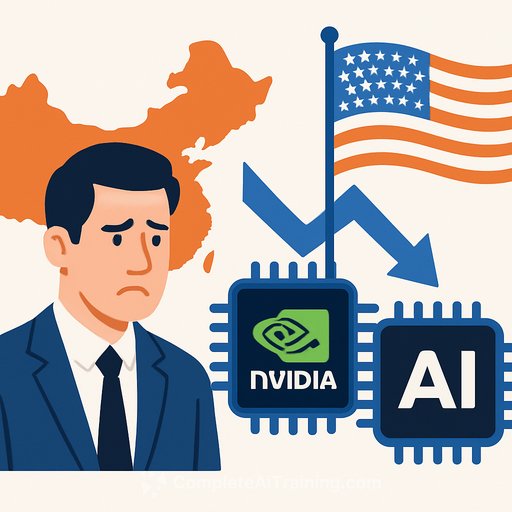
U.S. Greenlights Nvidia and AMD AI Chip Sales to China - What Sales Teams Need to Do Now
As reported by TechCrunch, the U.S. has allowed Nvidia's H200 and AMD's AI chips to be sold to Chinese customers after lifting prior restrictions. These are the processors behind large model training and high-intensity inference - the stuff your customers ask for when they say "we need more GPU."
The move triggered blunt pushback at Davos from Anthropic's CEO, Dario Amodei. He warned the decision "will come back to bite the U.S." and called sending advanced chips to China "a big mistake," citing "unparalleled national security implications." In his words, future AI could resemble "a nation of geniuses in a data center," and he compared the policy shift to "selling nuclear weapons to North Korea and bragging about Boeing building the shells."
The tension is notable because Nvidia isn't just any vendor to Anthropic - it supplies the GPUs that run its models and has committed up to $10 billion in investment. Translation for sales: industry alliances and public messaging can split overnight. Your customers will feel that shift, and it will show up in objections, timelines, and contracts.
Why this matters for your pipeline
- Allocation and timelines: Expect reprioritization of supply as Chinese demand re-enters the queue. Global lead times and deal commit dates may move.
- Pricing discipline: With more buyers in play, discount windows can tighten. Prepare stakeholders for firmer quotes and shorter quote validity.
- Compliance friction: China-related opportunities will require extra export-control checks and documentation. Bake this into cycle time and success criteria.
- Cloud spillover: If on-prem GPUs stay scarce, customers may shift to reserved cloud GPU capacity. Position hybrid options and cost tradeoffs early.
- Objection handling: National security headlines invite scrutiny from legal, procurement, and boards. Equip reps with a clean compliance narrative.
Sales plays to run this quarter
- Forecast on allocation signals: Request written allocation guidance from distributors and hyperscaler partners. Tie commit bands to those signals, not wishful thinking.
- Add export fields to CRM: End-customer, country of use, ultimate application, and reseller chain. Require signed attestations before quoting.
- Package "delivery certainty": Lead with availability tiers (now/next quarter/waitlist) plus substitution SKUs and cloud alternatives. Don't let "no stock" kill the deal.
- Pre-negotiate substitutions: If H200 slips, have H100/HGX-class or AMD equivalents approved. Include swap clauses in MSAs.
- Create a GPU waitlist with deposits: Protect priority for high-intent customers and lock in pricing windows.
- Co-sell with clouds: Offer reserved instances and capacity reservations when on-prem racks can't land in time.
- Tighten partner vetting in China: Work only with vetted entities, confirm end-use, and align with current BIS rules before you advance the stage.
Messaging that converts (and keeps legal calm)
- Lead with compliance readiness: Clear export checks, traceable chain of custody, and documented end-use.
- Sell delivery confidence: Dates, allocation tier, and contingency plan - on the first call.
- Quantify total cost: Power, cooling, rack space, and engineer time. Show where cloud or mixed deployments reduce near-term risk.
- Neutral tone on geopolitics: Acknowledge the headlines; redirect to concrete risk controls and business outcomes.
Qualifying questions to add now
- What's the target go-live and model size (params, tokens/day)?
- On-prem or cloud preference, and why? Any flexibility if supply shifts?
- Data center readiness: power (kW/rack), cooling, and floor space?
- Export jurisdiction, end-customer entity, and country of use? Any resellers in the chain?
- Procurement gating items: legal review, security review, board sign-off?
Signals to watch
- Official updates from U.S. Commerce/BIS and fresh thresholds for AI chips.
- Vendor commentary on supply during earnings calls and partner briefings.
- Public statements from major model labs; at Davos, Amodei's comments were unusually direct. See Bloomberg's coverage here.
- Media coverage for context and buyer sentiment; see TechCrunch.
If you sell into China
- Confirm the latest export requirements before quoting. Re-check at every stage change.
- Use phased SOWs: compliance verification first, hardware second, services third.
- Include pause/terminate rights if regulations shift mid-deal.
Bottom line
The policy shift opens doors and adds friction at the same time. Your edge comes from fast qualification, honest availability, and airtight compliance.
Set expectations early, document everything, and offer credible substitutes. Do that, and you'll keep deals moving while everyone else hesitates.
Skill up your team
If your sellers need a quick way to speak credibly about AI infrastructure, targeted learning paths by role can help. For executives approving large AI investments, see the AI Learning Path for CIOs; for leaders responsible for deployment and governance, see the AI Learning Path for Technology Managers; and for engineering teams deploying hardware and integrating workloads, see the AI Learning Path for Software Engineers.
Your membership also unlocks: