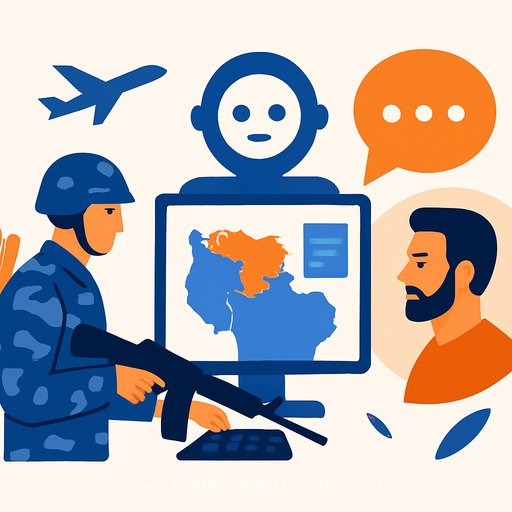
Report: Pentagon Used Claude AI in Operation Targeting Venezuela's Maduro
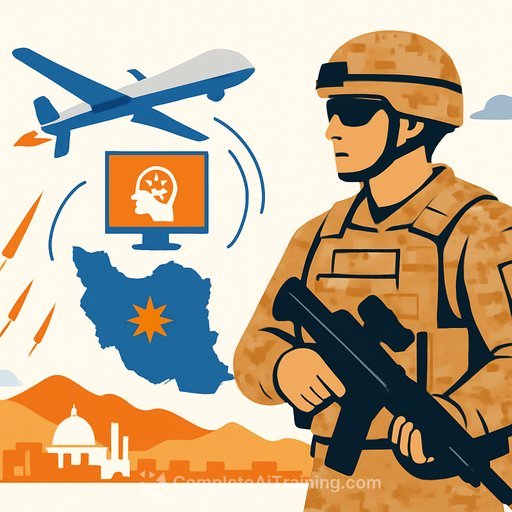
A Wall Street Journal report claims the US military used Anthropic's Claude in a classified operation last month that led to the capture of Venezuela's then President Nicolás Maduro. The model was reportedly deployed via Palantir's stack inside classified environments-despite Anthropic's usage policies that prohibit facilitating violence, weapons development, or surveillance.
The report says Maduro and his wife were taken in Caracas after several sites were bombed, and that he was later photographed aboard the USS Iwo Jima on January 3, 2026. The US government is said to be bound by Anthropic's usage policies even in classified settings, creating friction between mission needs and vendor rules.
What's new-and why ops leaders should care
- Policy vs. mission conflict: A commercial AI model with firm usage restrictions was reportedly used in a kinetic operation. That's a governance and compliance fault line.
- Third-party exposure: Claude entered the workflow through Palantir's partnership. Your AI risk surface now includes every integrator tied to your core vendors.
- Contract risk at scale: The Journal reports US officials considered canceling up to $200M in contracts over policy concerns. Procurement choices can flip into program delays or re-competitions overnight.
- Classified access is rare: Most vendors operate on unclassified networks. Claude appears to be one of the few accessed in classified settings via partners, raising unique audit and control requirements.
Where key players stand
- Anthropic: "Any use of Claude…is required to comply with our Usage Policies." The company has been vocal about guardrails, opposing autonomous lethal use and domestic surveillance.
- Pentagon: Defense Secretary Pete Hegseth reportedly said DoD would not work with AI models that "won't allow you to fight wars," referencing discussions with Anthropic.
- Palantir: Partnership enabled Claude's deployment in defense workflows, showing how system integrators can extend policy obligations into classified domains.
Operational implications
- Policy mapping is non-optional: Map vendor usage policies to your mission use cases before deployment. Flag red zones (e.g., targeting, surveillance, kinetic support) and define workarounds or alternate vendors.
- Contractual clarity: Bake usage-policy alignment into SOWs. Add clauses for policy-change notification, approved exceptions, model-switch rights, and termination for cause tied to policy conflicts.
- Multi-vendor fallback: Build a bench (model redundancy) for restricted tasks. Where one model's policy blocks a use case, another vetted option should be ready.
- Governance and logging: Require audit trails, model cards, prompt/output logging, and lineage tracking-especially in sensitive or classified environments.
- Human-in-the-loop by design: Codify review gates for target validation, surveillance cues, and action recommendations. Define escalation and override protocols.
- Safety boundaries: Establish kill switches, rate limits, and enforced policy guardrails at the orchestration layer-don't rely on vendor policies alone.
- Testing up front: Red-team for misuse, policy evasion, and mission-critical failure modes. Approve use cases at the scenario level, not just the capability level.
30-day action checklist
- Inventory every AI system, integrator, and model in use. Note where vendor policies could block mission tasks.
- Run a policy-to-use-case gap assessment. Document exceptions needed and the risk rationale.
- Amend contracts and SOWs to include policy alignment, notification windows, and vendor swap rights.
- Stand up model redundancy for any mission-critical workflow. Prove failover in a tabletop exercise.
- Implement centralized logging and a rapid legal/ethics review path for edge cases.
- Train operators on AI limits, escalation steps, and evidence capture for post-action reviews.
Context and references
The Journal's reporting also notes US officials weighed canceling up to $200M in contracts due to Anthropic's restrictions, and that the company had signed a major defense agreement last summer. Anthropic's CEO Dario Amodei has publicly called for stronger guardrails to prevent harm, including opposition to autonomous lethal use and domestic surveillance.
For policy grounding, see the DoD's AI Ethics principles and guidance and compare them with vendor usage rules before fielding systems:
Skills and upskilling
If your team needs structured training on deploying and governing Claude in high-stakes environments, these resources can help sharpen policy, prompt, and oversight practices:
Note: This article summarizes claims reported by the Wall Street Journal. Treat the operational guidance above as general best practice while you validate details through official channels.
Your membership also unlocks: