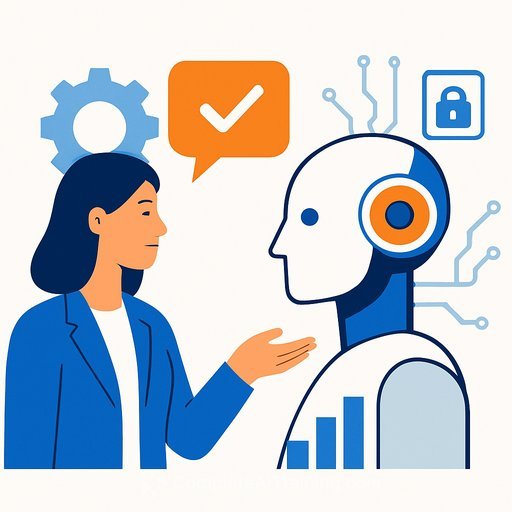
Should employees tell their manager they use AI? HR's answer: yes - and here's how to make it work
Employees are using tools like ChatGPT to draft emails, summarize reports, and clear routine work. Most companies still lack a clear policy, so people do it quietly.
The tech isn't the issue. The silence is. HR's job is to turn hidden usage into safe, visible, high-quality output that moves work forward.
Why transparency beats secrecy
Secret AI use creates legal, privacy, and accuracy risks. It also erodes trust when output looks "too polished" and no one knows how it was made.
Open use lets HR set expectations, put guardrails in place, and reward employees for improving speed and quality. That's how you shift time from grunt work to higher-value projects without sacrificing standards.
Top risks HR should address
- Data leakage: Employees pasting customer info, PII, or confidential docs into public tools.
- Inaccuracy and bias: Drafts that sound confident but get facts wrong or introduce bias.
- Copyright and IP: Using generated content without checking rights or vendor terms.
- Vendor risk: Unknown data retention, training, or security practices.
What HR should do this quarter
- Publish a one-page interim policy. Don't wait for perfection. Ship v1, iterate monthly.
- Sanction tools and use cases. Approve a short list. Ban use with sensitive data unless you have enterprise controls.
- Require disclosure. Add a simple note in docs or tickets: "AI-assisted for outline/grammar. Human reviewed by [Name], [Date]."
- Set "human in the loop." People are accountable for accuracy, tone, compliance, and ethics.
- Create audit trails. Save prompts and outputs for material work, especially customer-facing, legal, or policy content.
- Train managers and teams. Show approved workflows, red lines, and how to review AI output fast.
Coach employees on how to disclose use
Give people the words. Keep it business-first, not a confession.
- "I've been testing approved AI tools to speed up routine tasks. Here's where it helped, what I reviewed myself, and how I kept data safe. Does this align with our expectations?"
That stance signals ownership, awareness of risk, and respect for standards.
Practical guardrails you can adopt now
- Never paste sensitive data (PII, health, payroll, legal, customer IDs) into public tools.
- Use approved prompts for common tasks (summaries, outlines, drafts). Keep a library.
- Always fact-check names, dates, numbers, links, and citations.
- Bias checks for hiring, performance, or employee relations materials.
- IP/copyright review for external content, brand assets, and images.
- Label AI-assisted output in docs, slides, or tickets when material portions are AI-generated.
If a manager reacts poorly to disclosure
Treat it as a change-management gap, not employee misconduct. Reset expectations: responsible AI use is encouraged, secret use is not.
Provide managers a short checklist: ask about data safety, review steps, and business impact. If the employee followed policy, thank them for surfacing it and share the workflow with the team.
Quick policy starter (copy, then adapt)
- Approved tools: [List]. Unapproved tools require written approval.
- Allowed use cases: Drafting, summarizing, brainstorming, grammar. No use for legal advice, medical advice, or final compliance decisions.
- Data rules: No PII, customer secrets, or confidential company data in public tools. Use enterprise instances when handling internal content.
- Quality and bias: Mandatory human review for accuracy, tone, bias, and brand style.
- Disclosure: Mark material AI assistance in deliverables. You are accountable for the final work.
- Records: Retain prompts/outputs for high-risk deliverables per retention policy.
Helpful references
- NIST AI Risk Management Framework - useful structure for risk, guardrails, and controls.
- EEOC guidance on AI and employment decisions - bias and adverse impact considerations.
Training and rollout
Don't overcomplicate it. Run a 45-minute session: approved tools, do/don't examples, disclosure practice, and a live review of an AI-assisted draft.
If you need a fast path to team upskilling, see curated options by role here: Complete AI Training - courses by job.
Bottom line for HR
Encourage disclosure, set clear guardrails, and reward responsible use. Hidden AI use is a risk; transparent AI use is a performance system.
Make it safe to speak up, make it easy to do it right, and your teams will spend less time on busywork and more time on work that actually moves the business.
Your membership also unlocks: