
AI news ·
'Violated' artists storm Parliament House to demand PM stop AI theft of songs and books
Australian artists protested, demanding AI firms need consent to use their work. The sector contributes $17 billion yearly, with artists claiming value is taken without pay.
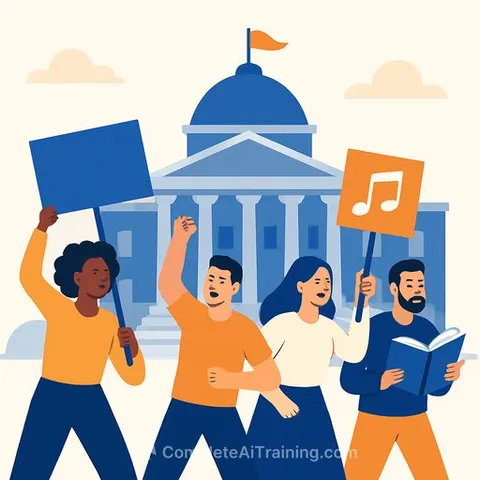
Australian musicians and authors protested at Parliament House on Tuesday, demanding the government block AI companies from using creative works without consent or payment. The direct action comes as technology firms intensify lobbying efforts to secure legal access to copyrighted songs, books, and other creative material for training AI systems.
The protesters delivered a clear message to Prime Minister Anthony Albanese: creative work is not free raw material for machine learning. Artists described feeling violated by the unlicensed ingestion of their life's work into commercial AI products.
Jimmy Barnes, the Scottish-born Australian rock singer, joined the delegation alongside novelists, songwriters, and visual artists. The group called for legislation that would require AI developers to obtain explicit permission before scraping copyrighted content and to compensate creators fairly when their work is used.
What the creatives are demanding
The delegation presented specific requests to lawmakers. First, an opt-in system that forces AI companies to seek consent before using creative works. Second, a licensing framework that ensures ongoing payment when songs, books, or artwork contribute to training datasets. Third, transparency requirements so creators can determine whether their work has been used to build AI models.
Current copyright law does not clearly address machine learning ingestion. AI firms argue that training on publicly available data constitutes fair use or falls under temporary copying exceptions. Creatives reject that interpretation, pointing out that commercial AI products then compete directly with the human work they consumed.
The lobbying push from technology companies
Behind the protest sits a regulatory battle. Tech companies have been meeting with government officials to push for permissive rules around data scraping. These firms argue that restricting access to Australian creative content would hamper innovation and leave the country behind in AI development.
For writers and musicians, the stakes are existential. A novelist whose books are fed into a large language model sees that same model later produce prose in their style - without a cent changing hands. A songwriter hears AI-generated tracks that bear the unmistakable fingerprint of their catalogue. The creative industries contribute an estimated $17 billion annually to the Australian economy, and many in the sector say that value is being extracted without their consent.
This tension between technology access and creator rights mirrors similar debates in the United States, where lawsuits from authors including John Grisham and George R.R. Martin are testing the boundaries of fair use doctrine. The United Kingdom has also faced artist backlash over proposed text and data mining exceptions. For professionals working across AI for Creatives, understanding the legal and ethical dimensions of these tools is becoming as important as technical skill.
What happens next
The Australian government has not yet signaled which way it will lean. The Attorney-General's department is reviewing copyright enforcement mechanisms, and the protest aims to stiffen the resolve of MPs who may be swayed by tech industry promises of investment and jobs.
Barnes and the other artists made clear they are not opposed to AI as a technology. They object to a business model that treats decades of human craft as free inventory. "We're not asking for special treatment," one participant said. "We're asking for the same respect any other industry gets when someone uses their work."
Why this matters for creatives
The outcome of this regulatory fight will shape whether creative work remains a viable career. If AI companies succeed in establishing unrestricted access to copyrighted material, the economic foundation of songwriting, authorship, and other creative professions could shift overnight. For authors and journalists, the implications are direct and personal - AI for Writers tools trained on unpaid creative labour threaten to devalue the very skills they automate. The Australian protest is one front in a global contest over who gets to profit from creative work in the age of machine learning.