
AI news ·
Virginia health systems expand AI tools for clinical notes, patient triage and record-keeping
Hospitals are deploying AI scribes that listen to patient visits and auto-generate clinical notes, with 81% of physicians now using AI in some form. Privacy concerns and inconsistent disclosure policies remain unresolved as adoption grows.
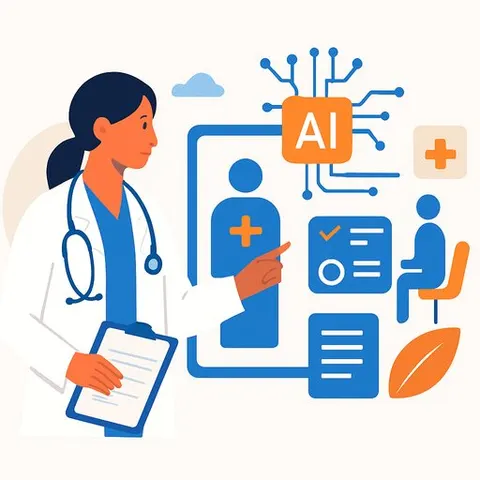
Healthcare Systems Deploy AI Scribes to Cut Provider Paperwork
Robbie Price, a nurse practitioner at Centra Health in Bedford County, has spent two decades taking clinical notes by hand, voice recorder, and voice recognition software. In July, his health system rolled out a new tool: an AI-powered digital scribe that listens to patient conversations and automatically generates complete clinical notes.
The software runs on a provider's phone, filters out non-clinical conversation, and produces a finished note within minutes of the visit ending. Price said it has been "transformational on the clinical end."
"It's kind of turned the providers from more creators of the note to more editors," Price said, who also serves as Centra's director of advanced practice provider operations.
The appeal is straightforward. Many providers spend what Price calls "pajama time" - evenings and weekends - completing documentation. Automation lets them finish records earlier and leave work sooner.
Carilion Clinic, based in Roanoke, began integrating AI-powered documentation tools around 2023. Dr. Maruf Haider, associate chief medical information officer at Carilion, said being more present during appointments helps clinicians recall details accurately when reviewing notes later. Patients can view notes during their visits if they choose.
"It's a more thorough note that, in some cases, picked up things that I would have not thought about putting in that was pertinent," Haider said.
Adoption Is Widespread but Concerns Persist
About 81% of physicians report using AI for tasks including searching medical research, triaging patients, communicating with patients, generating discharge instructions, and documenting visits, according to a 2026 survey by the American Medical Association.
Healthcare leaders largely view the shift positively. AI can improve efficiency, reduce administrative burdens, and help address clinician burnout, said Beth Bortz, president and CEO of the Virginia Center for Health Innovation.
But some patients - particularly younger generations - express hesitation. Many ask questions about how their personal information is stored and used.
That concern often centers on third-party vendors that provide the AI services. Many AI tools are developed and implemented by outside companies, introducing additional layers of data access, responsibility, and risk, said Gurkan Akalin, executive director of the Institute for Applied Data Analytics at the University of Virginia's College at Wise.
Dr. Maxim Topaz, who develops AI technologies to improve patient-clinician interactions at the Columbia School of Nursing, said AI accuracy varies widely between clinical settings. Legal and ethical frameworks have not kept pace with adoption, which may discourage transparency about how the tools are used.
Data Security and Privacy Requirements
Hospitals must comply with HIPAA security rules, which govern how protected health information is stored and transmitted electronically. The law, enacted in 2003, requires administrative, physical, and technical safeguards to protect patient privacy.
Federal guidance is designed to be flexible and technology-neutral, allowing health systems to adopt new tools while maintaining compliance, according to the U.S. Department of Health and Human Services.
Dr. Stephen Morgan, senior vice president and chief medical information officer at Carilion, receives hundreds of vendor proposals annually. "Buyer beware in these cases," Morgan said. "Some of them have very good data. Some do not have peer review data or data that we would really trust."
Hospital leaders say any new technology needs to be vetted for security and privacy concerns before adoption. That may slow deployment, said Jen Halikman, Centra's vice president of applications information technology. "I'm sort of the IT governance grim reaper," she said.
Centra obtains patient consent to use AI and renews that permission annually. Providers are instructed to tell patients when they're being recorded, and patients can revoke consent at any time. If a patient declines, the provider conducts the visit traditionally.
Not every health system is as transparent about its use of AI tools. There is no federal mandate requiring disclosure, and health system policies vary widely, according to Topaz. "The analogy I use: We require informed consent when a medical student participates in a patient's care. AI is at least as consequential," Topaz said.
Providers Remain Responsible for Accuracy
When software generates clinical notes, errors can occur. The provider who signs the note remains responsible for its accuracy, Price said.
"The provider, at the end of the day, is still responsible for the note they signed because their name was on it," Price said. "But if you take having to create a note from scratch versus having to go through and edit a few paragraphs, it really does decrease the burden on the provider."
Halikman said Centra providers have reported few errors about the AI digital scribe to the information technology department. As providers use it, the AI model improves based on the data it receives from them.
Human providers still retain responsibility for making important medical decisions. Patient advocacy organizations are examining how AI intersects with care, said Gwen Darien, executive vice president of advocacy and education with the Patient Advocate Foundation, a nonprofit based in Hampton.
Patients should feel empowered to ask providers how they use generative AI and how they verify the accuracy of AI-generated notes, Darien said. Reducing administrative burdens for healthcare workers could improve the patient experience, but AI should be viewed as a tool - not a solution.
AI Accelerates Stroke Diagnosis and Message Triage
Since 2023, Centra has used an AI-powered platform to speed up stroke diagnosis. The system cuts the time from "door to read" - when a patient enters the hospital to when their brain scan images are read - in half by analyzing images and sending them directly to a provider's phone or computer.
The final diagnosis still comes from a human radiologist. "We still need humans to be able to look at these images and really give us the right call. It's just partnering with us to make the efficiency of how we treat stroke even better," said Mandi Zemaiduk, director of practice operations at Centra Medical Group Neurology.
Carilion uses AI to triage patient messages sent through its MyChart portal. When a patient submits a question, the system can generate a draft response for the provider to review and edit. AI-generated suggestions are designed to reflect a clear and empathetic tone.
AI can conduct an initial review of incoming messages and flag them based on urgency. "They were getting just dozens and dozens of messages through the portal and feeling like, my God, how do we keep up with this?" Bortz said. "And now they use AI to help with reviewing those messages and triaging the messages."
Training the Next Generation of Clinicians
As these tools evolve, hospital leaders are considering how autonomous these systems should become. That shift could change how future clinicians are trained.
Dr. Zachary Williams, emergency department medical director at LewisGale, said medical educators now face a balancing act. Young doctors need to understand how AI tools function, but they must also develop strong independent note-taking and clinical reasoning skills.
Haider said that soon medical students who grew up with AI will enter practice. "Maybe knowledge recollection is not as important as the decision-making and verifying," Haider said.
What's Next: Expanded AI Integration
Centra is exploring AI-generated patient summaries beyond clinical notes. A provider could ask an app for the last two years of a patient's complete blood count results, or use AI to help put in patient orders.
"In the clinical space, there are a lot of AI agents that we plan to roll out starting in 2026," Halikman said.
Carilion plans to introduce similar AI agents into nursing workflows. As the largest segment of the clinical workforce, nurses form the backbone of hospital operations, and integrating AI into their tasks could significantly improve efficiency, Morgan said.
AI could also streamline scheduling. By analyzing a patient's medical history and reason for visit, an AI agent could recommend a 15-minute appointment or allocate an hour, depending on patient needs.
Some experts believe AI could eventually handle more direct patient interactions. Xuan Wang, an assistant professor in the Virginia Tech Department of Computer Science, has studied whether AI can improve how patients are triaged in emergency departments.
For now, AI agents' abilities are limited. "They can provide knowledge but they do not act like doctors. Doctors usually ask follow-up questions. The models are not really that doctor-like," Wang said.
Wang is also researching whether AI can help reduce bias in patient care - bias that healthcare providers have historically displayed toward women, people of color, and people with disabilities.
"My own hypothesis is they probably help reduce the bias because the models only see the conversation, basically. They don't have the personal information, they don't know who they are talking about," Wang said.
Hospital systems are preparing to expand AI use. Morgan said the focus remains on efficiency and supporting decision-making, not replacing clinician judgment. "It's really about how to improve that efficiency," Morgan said.