
AI news ·
White House unveils Gold Eagle clearinghouse for AI cyber threats
The White House launched Gold Eagle to share AI-discovered cyber flaws. The program protects the U.S. financial system from attacks like the 2021 Log4J breach.
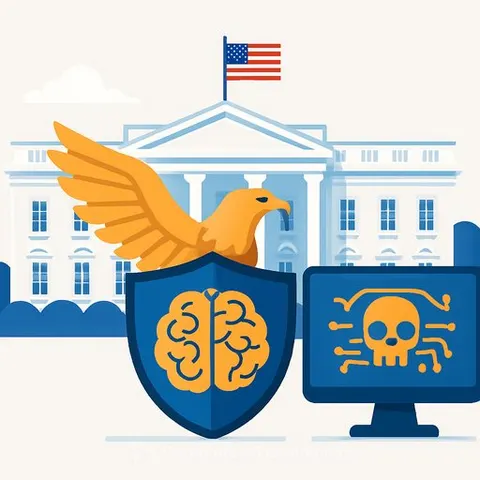
The Trump administration's new federal clearinghouse for sharing AI-generated cyber threat intelligence has already begun receiving vulnerability reports and prioritizing patches, the White House confirmed. The initiative connects government agencies with private-sector partners to fix security flaws discovered by artificial intelligence before adversaries can exploit them.
Created through an executive order last month, the program-dubbed Gold Eagle-is managed by the Department of the Treasury, with contributions from the Cybersecurity and Infrastructure Security Agency (CISA), the Department of Homeland Security, and the Department of Defense. Open-source software providers, critical infrastructure operators, and industry partners also feed into the effort.
"Under President Trump's leadership, the Treasury Department is working hand in hand with the private sector to safeguard our financial institutions, close vulnerabilities, and protect the integrity of the U.S. financial system," Secretary of the Treasury Scott Bessent said in a statement. "Treasury, along with our partner agencies, will continue to harness frontier AI capabilities to stay ahead of our adversaries and defend the American people from emerging threats."
How Gold Eagle operates
Gold Eagle aims to help both public and private organizations find, fix, and patch vulnerabilities detected using AI tools before malicious actors can exploit them. The work involves using AI to scan victim systems and software for weaknesses. Secretary of Homeland Security Markwayne Mullin said the initiative would also explore additional ways to apply the technology to cyber defense.
A senior White House official told reporters on a background call that closed-source models from frontier AI developers, including Anthropic's Mythos, will be used to discover vulnerabilities. The White House worked with the Software Engineering Institute at Carnegie Mellon University to develop a new platform called the Vulnerability Information and Coordination Environment, or VINTS, to receive third-party reports on AI-discovered vulnerabilities. The system has already started collecting intelligence and prioritizing patches.
"I think on the early side of this, we have seen that the scale of vulnerability discovery, particularly with users of new technology to scan their system, is something that is a step function change than we've seen before," the official said.
The open-source challenge
AI models have improved at core cybersecurity tasks like scanning code for vulnerabilities and developing proof-of-concept exploit code. The modern internet contains widespread insecure code, misconfigurations, and other mistakes that AI tools can identify and exploit faster than ever before. Vulnerabilities in open-source software are particularly dangerous-they can be both widespread and hidden, since many commercial products rely on open-source code but rarely document that dependency.
The 2021 Log4J incident illustrated the scale of the problem. When hackers compromised a logging tool in the Apache open-source software library, it required a months-long coordination effort by CISA, the private sector, and other stakeholders to find and fix affected software. The White House official said Gold Eagle reflects the administration's "full support" of U.S. open-source software providers and maintainers, calling open-source tools "vital to systems that run throughout our country and daily life."
For government cybersecurity teams looking to build expertise in this area, an AI Learning Path for Cybersecurity Analysts provides structured training on applying AI to threat detection and vulnerability management workflows.
Expert perspective on AI threats
Michael Daniel, former White House cyber coordinator under President Barack Obama, said policymakers are still observing AI's impact and adapting their response. Some existing channels for sharing cybersecurity threat information could likely be duplicated for tracking AI threats, but there is still much to learn about the technology, the threats it produces, and its ecosystem of stakeholders.
"It may turn out at the end of the day that phishing is still phishing, and the fact that now you've got AI tools doing it, it's still phishing. Or there may be something fundamentally different about it that we need to figure out how to combat and share information around," Daniel said.
Why this matters for government professionals
Gold Eagle signals a structural shift in how federal agencies approach vulnerability management. The clearinghouse model means cyber threat intelligence discovered by one agency using AI tools can now flow to others-and to critical infrastructure operators-through a formalized channel. For government IT and security professionals, this creates an early-warning pipeline that did not exist at this scale before. The VINTS platform also means third-party researchers have a direct path to report AI-discovered flaws to the government. Agencies that invest now in understanding how to triage and act on this intelligence will close vulnerabilities faster than those waiting for traditional disclosure processes. For professionals seeking broader AI literacy in government contexts, AI for Government training resources cover the policy and operational dimensions of emerging federal AI initiatives.