
AI news ·
WHO drafts global long-term care standards as China scales AI surveillance to 300 million people
China deployed AI in long-term care for over 300 million people, distributing $16 billion since 2016. The WHO is now drafting first international standards to balance efficiency against privacy risks.
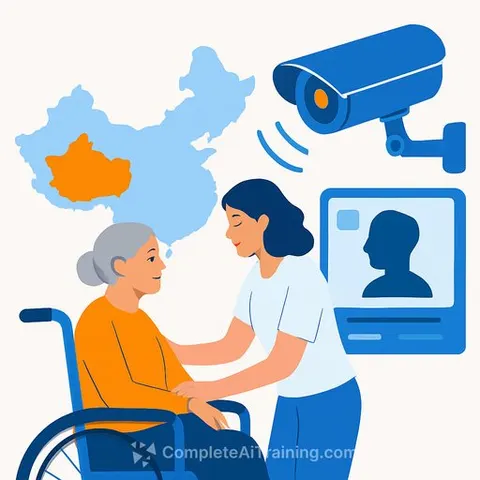
China's AI Long-Term Care System Raises Global Questions on Privacy and Standards
China has deployed artificial intelligence across long-term care services for over 300 million people, distributing more than $16 billion since 2016. The scale is unprecedented: Ant Health Business Group's platform alone serves 120 million users and processes 10 million daily interactions. This expansion has prompted the World Health Organization to develop the first international standards for AI in long-term care, balancing efficiency gains against ethical risks.
The system relies on continuous algorithmic surveillance. Millimetre-wave radar monitors vital signs during eligibility assessments. Thermal imaging tracks patients in their homes. Facial recognition binds care workers to specific locations and timestamps. In Shandong province, supervisors cross-reference recipients' public transit logs to flag unusual mobility patterns.
These systems deliver measurable efficiency. Shanghai's Changning district uses AI to generate care plans automatically, cutting manual workload. Chongqing compresses disability evaluations from 15 days to five using deep-learning skeleton recognition. Nationally, digitised assessment applications have eliminated paper bottlenecks.
The efficiency argument drives adoption globally. The WHO Regional Office for Europe found that 96% of EU member states cite workforce pressure as a primary reason for implementing AI in healthcare. At the University of Geneva's Stroke Center, clinicians use AI models to predict patient outcomes across 2,700 cases.
Privacy Protections Remain Fragmented
The privacy cost is severe. Wang Hongbo, deputy director general of China's Shandong Healthcare Security Administration, acknowledged that maintaining care setting privacy directly conflicts with state supervision requirements.
Local governments have engineered workarounds. Officials in Nantong translate raw monitoring footage into anonymised stick figures before sending data to state supervisors. But these fractured approaches lack binding enforcement. The 2024 WHO guidance on AI ethics stresses that privacy failures undermine public trust, yet these guidelines lack enforcement mechanisms to standardise protections across borders.
Health AI CEO Ricardo Baptista Leite warned that emerging markets must establish strict data sovereignty to avoid relying entirely on foreign-owned solutions. The Union for International Cancer Control's Philippe Guinot said health systems must validate AI solutions, ensure transparent models, and address algorithmic bias through robust governance.
WHO Drafts First Long-Term Care Standards
The WHO has released a consultation draft establishing the first international standards tailored specifically to long-term care. The framework covers eight operational areas: definitions, principles, home and facility-based care, unpaid carers, workforce, financing, governance, and quality monitoring.
The standards anchor five foundational principles: rights-based delivery, person-centred care, autonomy, and preventing social exclusion. Critically, WHO avoids prescribing a single rigid model. Instead, it advocates "progressive realisation," allowing nations to adapt standards based on their economic resources and existing care system maturity.
WHO Medical Officer Dr Hyobum Jang said the standards function as "expectations, agreed principles, and contracts between providers, governments and people who receive long-term care." They are not precise numerical targets but operational benchmarks.
WHO officials asked China's government to participate in the global public consultation and contribute its regulatory experience. Li Mingzhu, a Chinese National Health Commission commissioner, said China stands ready to work with other countries on data governance, algorithmic ethics, and product regulation to prevent a new digital divide.
The Governance Gap
Technological advancement is outpacing regulation. Major health corporations are already embedding AI into long-term care business models while massive data collection creates operational realities on the ground.
Sophia Achab, co-chair of the Geneva Health Forum, said ethical AI is non-negotiable and demands strict human oversight to prevent over-reliance on technology and ensure equitable access regardless of socioeconomic status. WHO's Ritu Sadana stressed that innovation must remain rights-based and human-centred, with older adults actively included in designing and governing AI systems.
The stakes are global. As Achab said: "Technology should serve humanity, not the other way around."
Healthcare professionals implementing or evaluating AI systems should understand these emerging standards. For those working in long-term care, AI for Healthcare and AI Data Analysis resources can help navigate algorithmic decision-making and surveillance trade-offs in clinical settings.