The Impact of AI on African Education
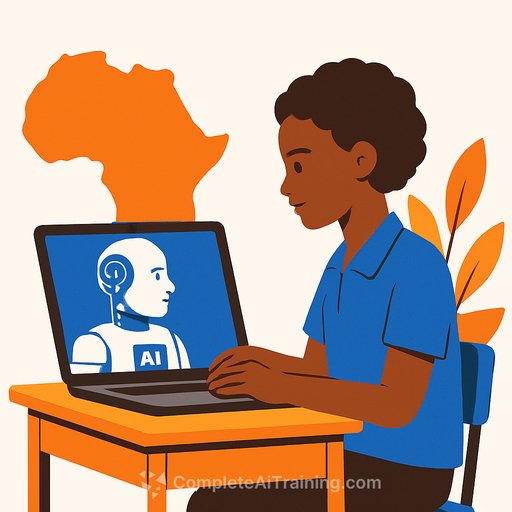
Picture a talented student from rural Limpopo presenting a case study grounded in local African challenges. Meanwhile, her classmate submits a perfectly crafted paper filled with American examples and Western solutions that don’t fit their context. The difference? The latter relied on ChatGPT, submitting a paraphrased AI response. This scenario reveals a crucial issue: generative AI is changing teaching and learning in higher education, but without thoughtful use, it risks widening the gap between relevance and convenience.
Digital Colonialism by Design
Many large language models like ChatGPT were created without African contexts in mind. Their training data favors Western knowledge, histories, and frameworks. Yet, across Africa, these tools are quickly becoming part of education systems without much scrutiny of cultural biases or teaching impacts.
This creates risks such as imposing Global North solutions on very different educational, technological, and socio-economic environments. For example, an AI tool tuned for English-speaking, well-resourced schools may exclude students in multilingual classrooms or those with limited internet access.
A deeper concern is digital colonialism—the way global tech platforms control what knowledge is visible, whose perspectives count, and how learning happens. This threatens academic independence and increases reliance on systems not built for African students or contexts.
Banning AI tools isn’t the answer. The real question is how to use AI thoughtfully, strategically, and with sovereignty.
Between Hype and Fear: Finding Balance
Too many institutions swing between two extremes: uncritical optimism that AI will solve every problem, and fear-driven rejection. What often gets lost are students who need guidance on how to use AI responsibly and shape it to fit African futures.
When AI Doesn’t Speak Our Language
An African law student using ChatGPT often receives US case law examples. Economic models tend to assume Western market conditions. Cultural insights are frequently Western assumptions presented as universal truths.
AI can provide localized information, but without skillful prompting and awareness of its limits, most users get default outputs shaped by Western data. This sidelines African perspectives. The hidden curriculum of imported AI quietly reinforces the idea that knowledge flows from North to South.
Meanwhile, African students and lecturers contribute data and insights without ownership, and Silicon Valley profits.
Reclaiming Technological Agency
What’s the alternative? Some institutions have adopted a technocritical approach. This mindset acknowledges AI’s promise and its pitfalls within local contexts. Here are five core principles guiding this approach:
- Participatory design: Students and staff co-create how AI is integrated into learning.
- Critical thinking: Learners critically evaluate AI outputs—what data is shown, and whose voices are missing.
- Contextual learning: Assignments compare AI results to local realities to reveal blind spots.
- Ongoing dialogue: Maintain open conversations about AI’s influence on knowledge inside and outside classrooms.
- Ethics of care: Promote African perspectives and protect against harm by ensuring AI use is inclusive and community-centered.
This approach is already in practice. For example, law students verify AI outputs against South African case law. Humanities students analyze AI alongside local satirical art. Commerce students compare AI economic summaries to real community patterns. These tasks expose Western-trained AI’s blind spots and encourage critical engagement with local realities.
A Call for Digital Self-Determination
The future of AI in African education depends on current choices. Will we passively apply foreign tools or actively shape AI to reflect African values and aspirations? It’s not a choice between relevance and progress. A technocritical approach allows for both, on our own terms.
Africa cannot simply adopt AI without adapting it. Students mustn’t be passive users of systems that ignore their realities. This is about digital self-determination—equipping future generations to question defaults and build AI tools that reflect African voices and knowledge.
AI will influence education’s future, but first, we must influence AI. Africa has the chance to move beyond consumption and co-create technology that honors lived experiences and knowledge systems. True innovation means confidently charting our own path.
Your membership also unlocks: