Did Klarna’s AI Reliance Affect Customer Service Quality?
Swedish fintech company Klarna has leaned heavily on artificial intelligence to handle its increasing workload for years, reducing its human workforce significantly. However, recent statements from CEO Sebastian Siemiatkowski reveal that this strategy has impacted service quality, prompting the company to bring more human agents back into the fold.
Since 2022, Klarna cut around 2,000 staff members and did not hire any new human agents in 2024. Their AI assistant, powered by OpenAI, handled what equated to 800 full-time agents' worth of customer conversations—more than 2.3 million interactions. Initially, Klarna claimed customer satisfaction with AI was on par with human agents.
Siemiatkowski once boldly stated that AI could perform all human jobs, including his own. But more recently, he acknowledged that the extensive job cuts led to a drop in service quality. He pointed out that cost-cutting focused too much on outsourcing human agents, which resulted in inconsistent service experiences for customers.
Outsourcing: A Cost Trap Affecting Service Quality
A Klarna spokesperson clarified that the CEO’s comments targeted the quality of outsourced human agents rather than the AI itself. Some customers received excellent support, while others dealt with less engaged representatives, causing repeated contacts and higher costs. To fix this, Klarna is now hiring part-time freelance agents to manage complex issues more reliably than the outsourced model allowed.
Lessons from Klarna’s Approach
Forrester analyst Christina McAllister points out that Klarna made a common mistake: underestimating the complexity of customer service while aggressively cutting headcount to save costs. She notes that customers generally expect lower quality from automated services due to years of subpar chatbot experiences. Changing this perception takes time.
McAllister emphasizes that the low-quality service wasn’t caused by AI adoption itself but by cutting too many human agents too quickly. AI still struggles with new scenarios, emotional interactions, and nuanced problems—areas where humans outperform technology. Companies blending AI with human backup tend to maintain higher customer satisfaction than those pushing AI too fast.
Klarna’s Course Correction
Klarna’s recent move to hire part-time customer service workers is a response to these challenges. The company has onboarded six remote freelance agents so far and plans to expand to about 100 if the pilot succeeds. Interestingly, Klarna aims to recruit from its own user base, tapping into passionate customers interested in supporting the brand.
The company remains committed to an AI-first approach, highlighting that its AI agent resolves queries in about two minutes, compared to 12 minutes for humans, saving an estimated $39 million in 2024. However, Klarna acknowledges that human agents will always play a vital role for complex or sensitive issues, offering customers a clear path to live support.
What Customer Support Teams Can Learn
- AI can handle high volumes efficiently but isn’t ready to replace human agents entirely, especially for complex issues.
- Cost-cutting via outsourcing can reduce service quality and frustrate customers, leading to repeated contacts and higher long-term costs.
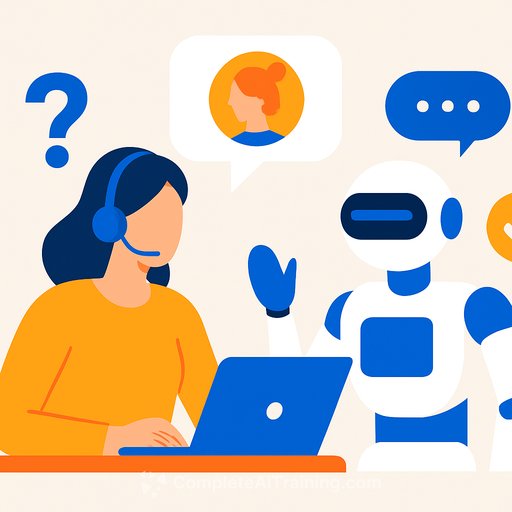
- A hybrid model—leveraging AI for routine queries and skilled humans for nuanced problems—offers the best balance.
- Hiring part-time or freelance agents can provide flexibility and improve consistency compared to outsourced teams.
- Engaging passionate users or community members as agents might boost service quality and brand loyalty.
For customer support professionals exploring AI integration, Klarna’s experience serves as a reminder to balance automation with human expertise carefully. If you’re interested in building skills around AI in customer service, consider exploring practical courses on Complete AI Training that focus on blending AI tools with customer support roles.
Your membership also unlocks: