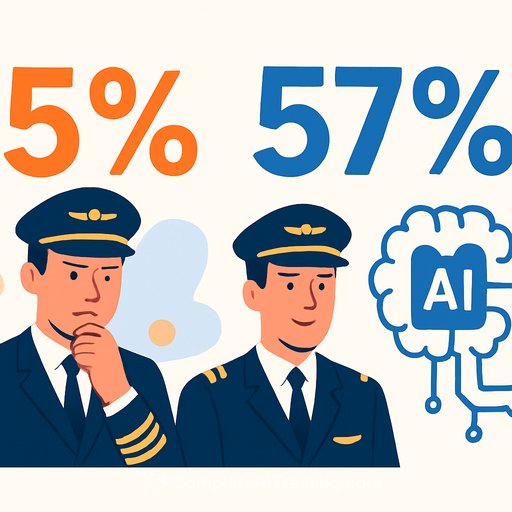
Artificial intelligence has attracted massive investment and excitement in recent years, fueled by bold promises of transforming every part of business. Yet, the gap between AI’s potential and actual business value remains wide. A study by BCG shows that while 98% of companies explore AI, only 26% have working products, and just 4% see significant returns. This raises a key question: why do so many AI projects fail to deliver meaningful results?
Knowledge Gap
A major factor is a disconnect at the leadership level. Although 94% of C-suite executives claim intermediate to expert knowledge of AI, and 90% feel confident making AI-related decisions, only 8% have substantial conceptual understanding, according to a 2024 MIT Sloan Management Review study. For AI to create real value, it must be aligned with the company’s broader architecture—its purpose, strategies, processes, and operating models. This alignment requires leaders who grasp both business goals and the technical side of AI.
Opportunity Costs
The gap between confidence and true competence creates risk. Without basic AI literacy, executives can’t effectively decide how AI initiatives fit strategic priorities or existing infrastructure. This often forces them to hand over critical choices to technical teams lacking business context, leading to wasted investments. Beyond failed projects, poor AI literacy causes strategic opportunity costs. CEOs unable to differentiate breakthrough AI from minor improvements may underinvest in transformative solutions or overspend on trendy but low-impact technologies.
What CEOs Need to Know
Leaders don’t need to build neural networks or master deep learning math. Instead, they need practical knowledge to connect AI efforts with core business operations and strategy. Here are three key areas every CEO should understand.
1. The Types of AI
CEOs should know the four main AI types, their business uses, and maturity levels.
- Analytical/Predictive AI: Focuses on pattern recognition and forecasting. It’s well-established and powers data-driven decisions in finance, manufacturing, and more.
- Deterministic AI: Uses fixed rules and logic to automate processes, boosting efficiency but requiring careful oversight.
- Generative AI: Creates new content like text and images. It offers creative possibilities but raises ethical concerns.
- Agentic AI: The newest form, which not only analyzes but takes actions toward goals. It holds major potential and risks but remains largely unproven at scale.
2. Technical Infrastructure Considerations
The infrastructure behind AI shapes what’s feasible for each organization.
- Deployment Models: On-premises offers control and compliance but demands investment; cloud provides scalability yet increases security and vendor risks; hybrid combines both.
- Open vs. Closed Systems: Closed systems are easier to deploy with vendor support but limited customization. Open-source systems offer flexibility but require more internal resources.
- Computing Resources: Most use AI mainly for inference, which needs less hardware than training models but limits customization.
- Data Infrastructure: Strong data pipelines, storage, processing, and governance are essential. Companies with mature data setups implement AI faster and more effectively.
3. The AI Tech Stack
AI relies on five layers that convert raw data into business value.
- Data & Storage: Collects and organizes structured and unstructured data.
- Compute & Acceleration: Uses GPUs, AI chips, and cloud clusters for heavy processing, managed by container tools for flexible deployment.
- Model & Algorithm: Includes foundation models, specialized language models, and machine-learning libraries. Decisions involve using models as-a-service, fine-tuning, or building custom networks.
- Orchestration & Tooling: Combines retrieval-augmented generation, prompt pipelines, and agent frameworks to create end-to-end AI functions.
- Applications & Governance: Interfaces AI with users through APIs and low-code tools, embedding intelligence while ensuring oversight.
Developing AI Literacy in the C-Suite
How can busy executives build the AI knowledge they need? Here are practical steps.
- Create a personal learning plan. Dedicate time to structured learning via executive programs, books, or online courses focused on AI for business leaders.
- Build a balanced advisory network. Surround yourself with experts who combine technical skill and business insight, including internal and external advisors who speak your language.
- Set up regular tech briefings. Have technical teams update you regularly on AI’s capabilities, limits, and applications, focusing on business impact rather than tech details.
- Experience AI hands-on. Use your company’s AI tools yourself to gain an intuitive grasp of strengths and constraints.
- Promote AI literacy organization-wide. Support AI education beyond technical teams. When leaders across functions share a common AI understanding, collaboration improves significantly.
Leadership in AI begins with curiosity and the willingness to learn. Executives who develop solid AI literacy don’t just keep pace with change—they make informed decisions that move their businesses forward.
For executives seeking structured AI learning resources, Complete AI Training offers courses designed specifically for business leaders looking to deepen their AI knowledge.
Your membership also unlocks: