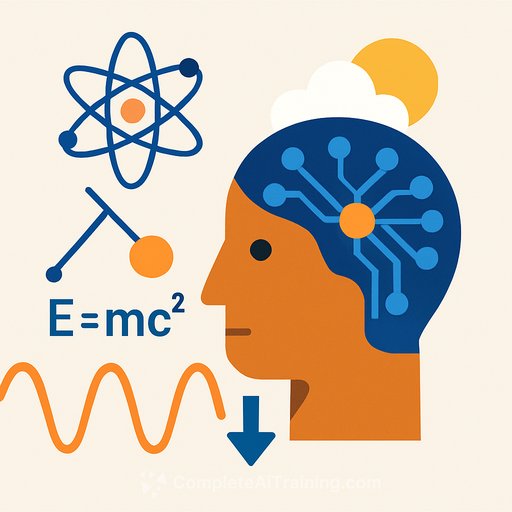
Maybe Physics-Based AI Is the Right Approach: Revisiting the Foundations of Intelligence
Over the last decade, deep learning has driven major advances in AI, improving image recognition, language models, and game strategies. But several issues remain: inefficiency with limited data, poor robustness to changes in input, high energy consumption, and a shallow understanding of physical laws. These problems become critical as AI expands into fields like climate science and healthcare.
One promising direction is physics-based AI, which integrates the laws of nature directly into learning algorithms. This approach draws from centuries of scientific knowledge, embedding physical principles into models to improve generalization, transparency, and reliability. The question isn't if we need to move beyond black-box models, but how soon this shift can be made.
The Case for Physics-Based AI
Why Physics, Now?
Current AI systems, including large language models and vision networks, mainly rely on spotting correlations in massive and often unstructured datasets. This method struggles in situations with limited data, safety requirements, or where physical rules govern outcomes.
- Inductive Biases via Physical Constraints: Embedding symmetries, conservation laws, and invariances narrows the search space, steering learning toward physically plausible solutions.
- Sample Efficiency: Models using physical priors can achieve more accurate results with less data, a key benefit in healthcare and computational science.
- Robustness and Generalization: Physics-informed models tend to fail less unpredictably when faced with new or out-of-distribution data.
- Interpretability and Trust: When predictions respect laws like energy conservation, they become more explainable and trustworthy.
The Landscape of Physics-Based AI
Physics-Informed Neural Networks: The Workhorse
Physics-Informed Neural Networks (PINNs) incorporate physical knowledge by penalizing deviations from governing equations, typically partial differential equations, within their loss functions. This technique has gained traction across various domains:
- Climate and geosciences: PINNs produce reliable predictions for complex free-surface flows affected by topography.
- Materials science and fluid dynamics: They simulate stress distributions, turbulence, and nonlinear wave propagation efficiently.
- Biomedical modeling: PINNs accurately model cardiac activity and tumor growth even with sparse data.
Recent advances (2024–2025) include unified error analysis for better training methods, physics-informed PointNet for handling irregular geometries without retraining, and multimodal architectures combining data-driven and physics-based components to tackle partial observability and heterogeneity.
Neural Operators: Learning Physics Across Infinite Domains
Traditional ML models struggle with variations in physical equations and boundary conditions. Neural operators, especially Fourier Neural Operators (FNOs), learn mappings between infinite-dimensional function spaces. They have excelled in:
- Weather forecasting: FNOs outperform convolutional networks in capturing complex nonlinear atmospheric and ocean dynamics.
- Addressing limitations like low-frequency bias through ensemble and multiscale techniques, improving high-frequency prediction accuracy.
- Multigrid and multiscale neural operators now set new standards in global weather prediction.
Differentiable Simulation: Data-Physical Fusion Backbone
Differentiable simulators enable models to optimize physical predictions end-to-end with gradient-based learning:
- In tactile and contact physics, they support learning in manipulation tasks involving contact-rich, soft-body, and rigid-body dynamics.
- Neuroscience benefits from large-scale gradient optimization of neural circuits.
- New physics engines like Genesis offer high-speed, large-scale simulations for robotics and learning.
- Multiple methods for differentiable contact physics are emerging, including linear complementarity problem (LCP)-based, convex optimization, compliant, and position-based dynamics models.
Hybrid Physics-ML Models: Best of Both Worlds
Hybrid models that combine data-driven learning with explicit physics codes are pushing performance boundaries:
- Tropical cyclone forecasts now extend much further using neural-physical hybrids.
- Manufacturing and engineering leverage blends of empirical data and physical constraints to overcome brittleness from purely black-box or first-principles models.
- Climate science benefits from physically consistent downscaling and uncertainty-aware predictions.
Current Challenges and Research Frontiers
- Scalability: Training physics-constrained models efficiently at scale remains difficult, though progress is ongoing in meshless operators and simulation acceleration.
- Partial Observability and Noise: Handling incomplete or noisy data is an open problem; hybrid and multimodal models show promise here.
- Integration with Foundation Models: Efforts focus on embedding explicit physical priors into general-purpose AI architectures.
- Verification & Validation: Ensuring models obey physical laws across all conditions remains technically challenging.
- Automated Law Discovery: PINN-based approaches are increasingly practical for discovering governing scientific laws from data.
The Future: Toward a Physics-First AI Paradigm
Shifting to physics-based and hybrid AI models is essential for building intelligence capable of extrapolation, reasoning, and even uncovering new scientific principles. Key directions include:
- Neural-symbolic integration that combines interpretable physical knowledge with deep learning.
- Real-time, mechanism-aware AI for trustworthy decisions in robotics and digital twins.
- Automated scientific discovery leveraging machine learning for causal inference and law identification.
Progress here depends on close collaboration between machine learning experts, physicists, and domain specialists. This convergence of data, computation, and scientific knowledge promises AI that can advance both science and society.
For those interested in expanding their expertise in AI and its applications, Complete AI Training offers a range of courses designed to build practical skills in emerging AI technologies.
Your membership also unlocks: