The Energy Efficiency of Artificial Intelligence vs. the Human Brain
Artificial intelligence (AI) has become a common tool for generating stories, lists, papers, and images based on prompts. As AI continuously learns from existing art, writings, and historical data, many wonder if humans can keep pace with these digital systems.
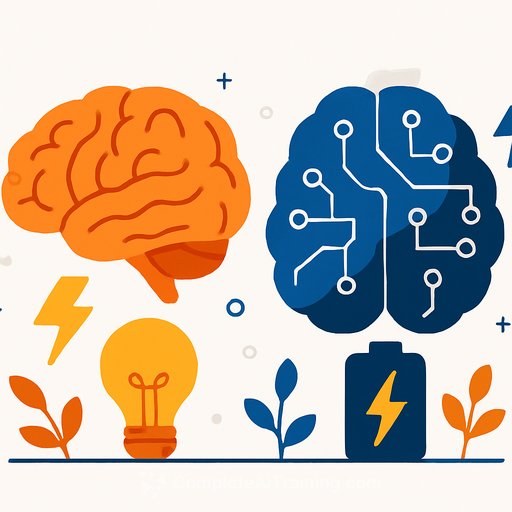
While AI is often positioned as a competitor to human creativity and problem-solving, the human brain remains unmatched in one critical area: energy efficiency. Research from Switzerland’s Blue Brain Project highlights that AI consumes far more energy than the human brain when performing similar tasks like writing, drawing, or calculating.
To put it in perspective, the human brain operates on roughly 12 watts of power. In contrast, simulating a human brain’s thought process with AI requires about 2.7 billion watts. This means the brain uses less energy than needed to light a bulb to process thoughts, while AI demands the equivalent power of 18 million laptop processors. The organic brain is millions of times more energy efficient.
The Energy Costs of AI
Developing and training AI systems already consumes vast amounts of energy. For example, training OpenAI’s ChatGPT-3 used electricity equal to powering 130 American households for a year. According to a 2023 report from MIT, generating a single AI image uses enough power to fully charge an average cell phone.
Additionally, TechRadar reports that a five-second AI-generated video consumes as much energy as running a microwave for over an hour. Beyond electricity, AI data centers also require massive water resources—equivalent to the daily water usage of 4,200 Americans—often sourced from regions facing water scarcity.
Unless significant improvements occur, AI’s energy and water consumption will remain far higher compared to the human brain, limiting its feasibility as an energy-efficient alternative for complex cognitive tasks.
AI vs. Human Brain: Speed and Multitasking
AI does have advantages in some areas. Calculation speed is one where AI outperforms humans, supporting scientists and medical professionals by quickly simulating scenarios and analyzing data, sometimes faster than supercomputers.
However, AI systems often require human supervision to correct errors and improve learning speed. Another key difference is multitasking: the human brain can handle several mental tasks simultaneously—like driving, singing, and remembering a grocery list—while current AI models process tasks sequentially. Overcoming this limitation depends on future advancements in AI processing power.
Conclusion
When it comes to energy efficiency, water consumption, and operational costs, AI cannot yet compete with the human brain. The brain’s natural design allows it to perform complex tasks with minimal energy use. Future improvements in AI may narrow this gap, but for now, the human brain remains the more efficient “processor.”
For those interested in learning more about AI capabilities and efficiency, Complete AI Training offers resources to explore current AI technologies and their practical applications.
Your membership also unlocks: