
AI news ·
Women are largely absent from the AI policy rooms that will shape their lives, Minnesota columnist argues
Women hold 80% of senior roles building AI strategies yet fill fewer than 15% of senior technical positions. Minnesota's AI policies are being written almost entirely by men, while women face 86% of automation-driven job displacement.
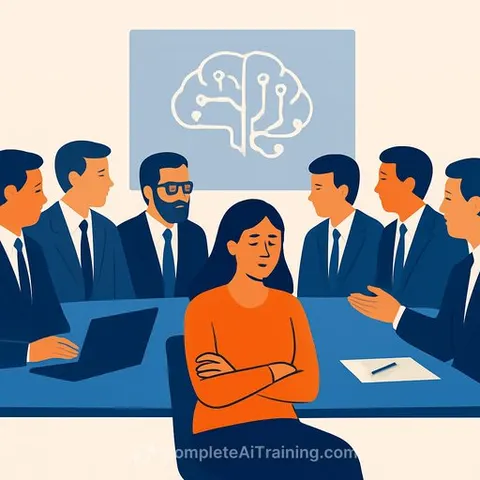
Women are largely absent from Minnesota's AI policy rooms. That's a problem.
White men are shaping AI leadership decisions in Minnesota and the Midwest, even as women do much of the work building those systems. The policies being written now will affect how women work, parent, age and move through digital spaces for decades.
State lawmakers are moving fast on AI regulation. Bills target job displacement from automation, restrict "deeply problematic" AI systems, and address nonconsensual explicit images generated by AI - technology that overwhelmingly targets women and girls. A proposed constitutional amendment would deny free-speech rights to AI agents and require disclosure when people interact with chatbots.
These are structural decisions that won't be easily reversed. Yet in legislative hearings and media coverage, male lawmakers and male experts are positioned as architects of the future. Women appear primarily as people needing protection rather than as people building the rules.
The pattern holds outside the Capitol
Minnesota's new AI hubs market themselves as connectors for researchers, innovators and industry leaders. The University of Minnesota's Data Science and AI Hub promises to advance "responsible AI." The Minneapolis AI Hub calls itself a movement.
Look at who gets named in the materials, whose faces appear, whose bios run long. Heavy on white men. The message is clear: AI leadership in Minnesota looks like them, not like the workforce living with what they build.
Regional summits across the Midwest sell themselves as places for executives building real AI strategies. Their lineups center on founders, executives and technical leads - mostly white men in visible expert slots. Organizations talk about human-centered AI and inclusive innovation while the room looks the same every single time.
Women are doing the work, quietly
Women hold 80% of senior roles building AI strategies, yet their work remains underrecognized. Still, they hold a minority of C-suite positions and get promoted into management at lower rates than men.
The risks are not distributed equally. Roughly 6.1 million U.S. workers face high risk of displacement by AI. Eighty-six percent of them are women, concentrated in clerical and administrative roles.
Women also adopt generative AI tools at lower rates overall, often because they're more likely to question ethics and real-world impact. ChatGPT usage data from late 2022 to mid-2024 shows women made up about 42% of website users, with an even wider gap in app downloads. Women represent less than 30% of the AI workforce globally. In senior technical roles, that number drops to around 15%.
The situation: Women are more exposed to AI's disruptions, more skeptical of its risks and less visible in the rooms defining it. That didn't happen by accident.
Examples of women actually leading
Elizabeth Adams has worked on responsible AI in Minnesota for nearly two decades. She leads the Minnesota Responsible AI Institute, which educates Minnesotans, develops responsible AI certification programs and builds workforce infrastructure. She was sounding the alarm long before AI became a priority for ribbon-cutting events.
The Twin Cities Innovation Alliance and its Data for Public Good initiative have been working on algorithmic justice, data transparency and community-centered technology since 2017 - years before ChatGPT. These Black-led organizations do foundational work locally but aren't being invited to cut ribbons or featured in major roundups.
Nationally, Miriam Vogel built EqualAI into a credible voice on AI governance and chaired the National AI Advisory Committee. Janet Haven spent more than 20 years at the intersection of technology policy and human rights. Christina Montgomery chairs IBM's AI Ethics Board and has been driving governance frameworks publicly for years. Noelle Russell published a book on scaling responsible AI inside organizations and leads certification work that changes how companies operate.
These women built credibility over years in rooms that didn't make space for them, on problems not yet considered important enough to fund. That is exactly why they should be at the center of this conversation.
What needs to happen now
The policies being shaped right now are being built by people who may never have lived the realities most women navigate daily. Those decisions will affect how women parent, care for aging relatives, access jobs and feel safe in digital spaces.
Women in policy, law, health care, education, HR, product, engineering, communications or community organizing have a stake in this moment - not as tokens, but as stakeholders with skin in the game.
That means asking who is at the table every time a task force or advisory council is announced. It means saying yes to speaking opportunities, panels and working groups, even when it feels like a stretch. Your lived experience is not a nice-to-have - it's missing data.
It looks like supporting and amplifying women-led firms, coalitions and networks doing policy and governance work. It looks like bringing other women with you, nominating colleagues for panels, mentoring younger women into AI-adjacent roles, and holding organizations accountable when "responsible AI" doesn't include responsibility for sharing power.
AI will not be neutral. It will reflect the people and power structures that build, fund and regulate it. Right now, that mirror is tilted toward a very narrow slice of human experience.
For executives and strategy leaders responsible for AI governance, understanding this representation gap is critical. AI for Executives & Strategy and AI for Government resources can help leaders build more inclusive decision-making processes.