The Gap Between AI Mandates and Employee Reality
Corporate leaders are pushing AI adoption hard. Shopify CEO Tobias Lütke calls it a "fundamental expectation" for workers. A September 2025 survey found that 24% of companies require AI use across all roles.
But employees aren't keeping pace with executive enthusiasm. While 74% of C-suite leaders reported feeling excited about AI, 68% of individual contributors reported feeling anxious or overwhelmed, according to a January survey from AI consulting firm Section.
The disconnect reflects a real problem: companies are mandating AI without accounting for the actual work required to use it well. "We never designed the workplace for these kinds of tools," says Dennis Stolle, head of applied psychology at the American Psychological Association. "We've just foisted it on people."
The Hidden Labor of AI
AI doesn't eliminate work - it shifts it. A January Workday survey found that 85% of employees said AI saved them one to seven hours weekly. But employees lost 40% of those gains by correcting, rewriting, editing, and fact-checking AI output.
Linda Le, a recruiter in Austin, Texas, experienced this firsthand. At a previous job, she and colleagues used AI to source, screen, and evaluate candidates. While AI quickly generated lists of qualified engineers, Le spent nearly half her time gains verifying results.
"Everyone talks about AI boosting productivity, but what they don't mention is how much time you spend babysitting the output," Le said. "It's definitely made some things faster, but it's not the magic bullet people think it is."
AI systems frequently made significant errors. The software would claim a candidate matched 95% of a job description, but closer inspection revealed only a 30% match. Other times, AI flagged well-qualified candidates as poor fits. Le had to constantly redo her work to catch these mistakes.
These errors add psychological weight. Workers worry about missing AI mistakes and facing consequences from managers. Google CEO Sundar Pichai acknowledged the problem in November 2025, telling the BBC that people "have to learn to use these tools for what they're good at, and not blindly trust everything they say."
Training Falls on Workers' Own Time
Companies aren't providing structured AI training. Only 27% of individual contributors said they received company AI training, and just 32% reported clear access to AI tools, according to the Section survey.
Devin Boudreaux, a digital PR strategist in Boise, Idaho, spent the past year and a half training custom AI models for his job. But his employer never provided training sessions or dedicated time for learning. A friend taught him most of his AI skills outside of work.
"Companies are urging employees to become AI proficient, but they want you to do it on your own time," Boudreaux said.
This creates an unsustainable cycle, according to Stolle. Employees are already busy during the workday, then feel pressure to spend evenings learning AI to keep up. "People are juggling multiple different tools and outputs, and they feel like if they stop paying attention to any one of them, something is going to drop," he said.
Mental Fatigue From Oversight
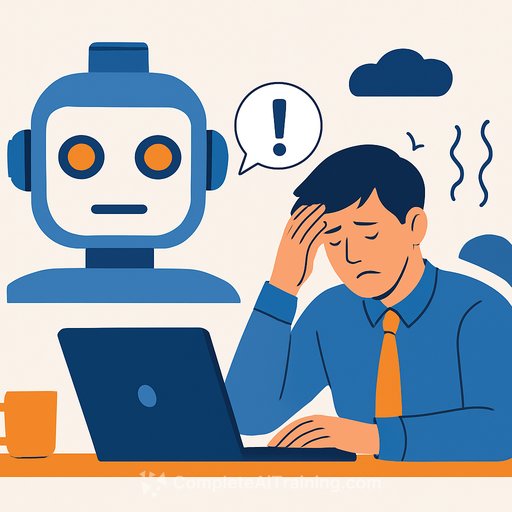
A recent Boston Consulting Group study identified a phenomenon called "AI brain fry" - mental fatigue that increases when workers frequently use AI. Those affected are more likely to make mistakes, feel overwhelmed, and struggle with decision-making.
The primary culprit: managing multiple AI tools simultaneously. Workers using three or more AI agents in their workflow experience more mental fog than those using one or two. Tasks requiring high oversight demand 14% more mental effort and cause a 12% increase in mental fatigue.
Even AI leaders acknowledge the strain. Francesco Bonacci, founder of Cua AI, wrote on X in February: "I end each day exhausted - not from the work itself, but from the managing of the work." Ben Wigler, co-founder of LoveMind AI, told AFP that using AI creates a "brand-new kind of cognitive load" from the need to constantly oversee models.
AI also increases workload scope. University of California, Berkeley researchers observed employees at a 200-person tech company who used AI tools. These workers "worked at a faster pace, took on a broader scope of tasks, and extended work into more hours of the day, often without being asked to do so."
What HR Leaders Should Do
Ben Smytheman, a chartered psychologist and senior vice president at LHH, a talent and human resources services company, says the pressure for immediate productivity is counterproductive. Workers can't master AI when they're overburdened or unprepared.
Julie Bedard, a managing director at BCG, emphasizes that executives set the culture around AI. Organizations should identify where AI helps more than it burdens employees. Workers in the BCG study reported less burnout when AI replaced routine or repetitive tasks.
Stolle's core message to employers: the goal isn't using more AI. "The goal has to be creating higher-quality work in a sustainable kind of way, so that when you're five years out, you still have a thriving organization filled with happy employees."
For HR teams, this means evaluating whether current AI mandates serve business goals or simply chase trends. It means allocating training time and resources. It means monitoring workload and mental health as adoption increases.
Learn more about implementing AI responsibly in your organization with resources on AI for Human Resources or explore strategic guidance through our AI Learning Path for CHROs.
Your membership also unlocks: