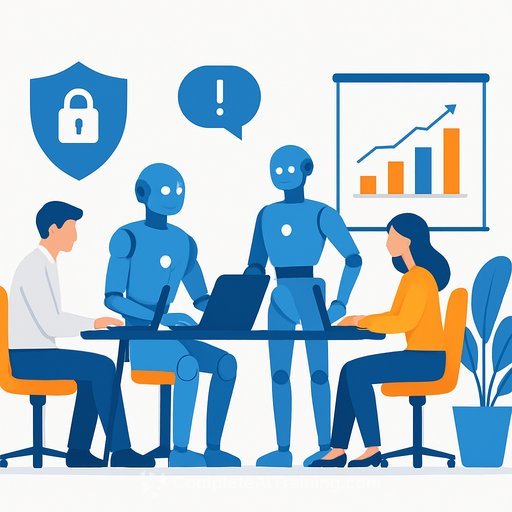
If AI Is the Intern, You're the Manager
AI coding assistants won't replace senior developers. They act like eager interns-fast, helpful, and prone to mistakes if you're vague.
That means your leverage isn't in clever prompts. It's in management: clear specs, tight boundaries, and checkpoints that make quality the default.
The Missing Skill: Smart Specs
Throwing a giant, one-shot prompt at an agent is why work drifts. Models have context limits and attention budgets. Bloat kills focus.
Smart specs fix that. They're concise, reusable across sessions, and structured so the model knows what matters and what's off-limits.
What a Useful AI Spec Includes
- Objectives and non-goals: State the goal and what's out of scope. Non-goals stop "helpful" refactors and scope creep.
- Context the model won't infer: Architecture constraints, domain rules, compliance requirements, integrations, data ownership.
- Boundaries: A "do-not-touch" list (production configs, secrets, legacy vendor dirs), and any permission limits.
- Acceptance criteria: Tests, invariants, edge cases, and the exact output format. Define "done" so review is fast and objective.
A good spec isn't an RFC. It makes drift expensive and correctness cheap.
From Prompts to Product Management
Treat the agent like a junior dev. Start with a short product brief. Let the model propose a spec. You then edit it into the source of truth and gate any code changes behind that spec, a plan, and small tasks.
Introduce review checkpoints before code is touched. If your team already struggles to communicate requirements, the agent will amplify the confusion-at a higher token bill. Fix the process, not the prompt.
Context Is a Product, Not a One-Off Prompt
Large prompts often underperform because they pile on instructions without structure. Think "context engineering"-a form of Prompt Engineering. Arrange background, constraints, tools, and outputs in a stable, predictable order so the model can follow it.
- Background: business goal, users, non-goals
- Constraints: architecture, security, compliance, performance
- Tools: repos, commands, APIs, datasets
- Output: exact file changes, diff format, tests to add, logging expectations
Your value shifts from syntax recall to being the context architect. You decide what matters and in what order the model should care.
Guardrails and Review Gates
- Do-not-touch: Explicitly list files, directories, and systems the agent can't modify.
- Permission boundaries: Read-only by default. Require approval to escalate.
- Small PRs: Force narrow changes with clear diffs and targeted tests.
- Pre-merge checks: Lint, security scans, unit/integration tests, and static analysis must pass.
- Rollout plan: Feature flags, canary deploys, and a rollback path.
Avoid the Code Ownership Trap
AI makes authorship cheap. Ownership-debugging, maintaining, and trusting the code-gets expensive if you stop practicing.
Use a hybrid approach. Let AI handle boilerplate. Downshift for novel work: write tricky parts yourself, then use the agent for tests, docs, and refactors. Keep your hands on the wheel.
- AI writes CRUD, scaffolding, config plumbing.
- You write core algorithms, cross-cutting concerns, and risky migrations.
- AI proposes tests; you demand edge cases and failure paths.
- Require code tours: the agent (or author) explains decisions file by file.
Operating Cadence for Managers
- Weekly spec reviews: One hour to sharpen objectives, non-goals, and boundaries.
- Definition of Done: Tests added, logs added, alarms configured, rollback defined.
- Metrics: AI PR size, time-to-merge, defect rate, rework rate, incidents tied to AI changes.
- Systematize learning: Save strong specs as templates. Promote reusable patterns to a team playbook.
A Quick Spec Template You Can Use Today
- Title + brief: One paragraph on the user problem and goal.
- Objectives: Bullet list of outcomes.
- Non-goals: What will not be built or changed.
- Constraints: Architecture, security, performance, compliance.
- Tools + repos: Paths, commands, APIs, datasets.
- Do-not-touch: Files, services, configs, directories.
- Plan + tasks: Steps with review gates, expected diffs, and test additions.
- Acceptance criteria: Tests, invariants, metrics, edge cases, output format.
- Rollout + rollback: Flags, canary, monitoring, revert steps.
Useful References
For a deeper look at structured prompting and context discipline, see Anthropic's guide: Prompt engineering best practices. For integrating AI into dev workflows, review GitHub Copilot documentation and resources on AI for IT & Development.
Next Steps
Pick a small feature. Write the spec using the template above. Gate the work behind that spec, review in small PRs, and track the metrics.
If you want structured practice for your team, explore role-specific programs here: Complete AI Training - Courses by Job.
Bottom Line
AI doesn't 10x weak process. It multiplies clarity. Managers who can translate business goals into sharp constraints will ship faster, safer, and with fewer surprises.
Write better specs. Install guardrails. Keep ownership. That's how you turn an AI intern into real leverage.
Your membership also unlocks: