
AI news ·
WWU professors split on generative AI as university holds off on formal policy
Western Washington University leaves AI policy to individual professors, producing wildly different rules across campus. Some ban computers entirely; others build AI avatars of themselves for students to consult.
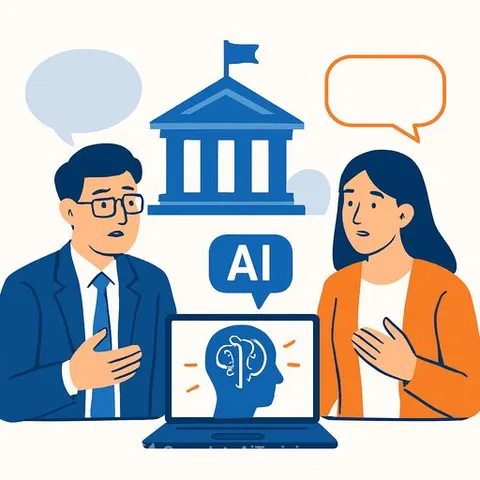
Western Washington University has no AI policy. Three professors show what that looks like in practice.
At Western Washington University, one professor teaches students to code their own AI agents while another has moved coursework offline and prints out readings to discourage AI use. The difference reflects the university's deliberate choice to avoid sweeping AI rules.
The university prohibits generative AI use in coursework by default unless a faculty member explicitly allows it. But beyond that baseline, professors operate independently. Provost Brad Johnson said the rapidly evolving technology affects different disciplines so differently that local decision-making makes more sense than university-wide mandates.
The approach leaves students navigating contradictory expectations across departments. Some professors ban computers entirely. Others encourage AI in all assignments. A few allow it only for grammar checking.
A university AI Task Force is forming in the Provost's Office, but it remains in early stages. Several faculty groups are separately exploring how AI affects teaching and learning, including the Faculty Senate's AI tools subgroup and the Critical A.I. Literacies Collective.
The energy professor who switched to pen and paper
Xi Wang, an assistant professor in environmental studies, noticed something off last year. Student responses to online reading prompts were mostly correct, but parts were "slightly inaccurate or off." Wang suspected generative AI was doing the work.
So Wang changed the class structure. Students now answer questions about readings with pen and paper at the start of class, with no notes allowed. The result: more substantive classroom discussions.
Wang permits students to use AI for grammar, punctuation, and structure, and as a search engine. Students cannot use it to generate original text. Wang doesn't use AI personally and is concerned about its environmental costs-data centers consume significant energy and water resources.
"The point of a college degree is about the critical thinking skills you develop, the literacy you develop around what is strong information, how to assess data sources," Wang said.
Wang participates in the Critical A.I. Literacies Collective, which has hosted teach-ins on topics including AI's environmental impact and corporate AI products. Wang pushes back against the assumption that AI adoption is inevitable.
Students in Wang's classes report that most professors now forbid computers entirely or assign in-class essays to prevent AI use. One student said a professor flagged a semicolon in her paper as potential evidence of AI use.
The marketing professor who embraces AI as a tool
Max Barahona, a visiting professor in international marketing, created an AI avatar of himself that students can interact with outside class. The avatar-which he calls "Max 2.0"-answers questions about course material but lacks his accent and depth.
Barahona uses AI five hours a day for professional work: creating videos, coding, writing emails, and generating quizzes. He encourages students to do the same, framing AI as a collaborator rather than a replacement.
He describes his approach as "agnostic" rather than enthusiastic. "People treat AI as very exceptional and unique," he said. "But we have had these dramatic technological changes many times before."
Barahona follows European AI standards, which are stricter than U.S. standards. He acknowledges what AI does poorly: critical thinking, creativity, intuition, and thinking outside conventional boundaries.
In one assignment, Barahona had students develop a marketing plan for a local product in another country first without AI, then using five different AI chatbots: Mistral, Perplexity, Claude, ChatGPT, and Gemini. Students found the AI responses had "a lot more fluff" than their own work.
The exercise teaches AI literacy by comparison. Students must understand marketing fundamentals before using AI to accelerate their work. "If you don't know what a good campaign looks like, your machine is going to give you something-you don't even know what you're looking at," Barahona said.
A senior marketing student said he was initially "gung-ho" about AI but the excitement faded as he realized how easy it is to use constantly. "I think you're losing the intentionality of what you're creating," he said.
The computer science professor guarding the fundamentals
Caroline Hardin, an associate professor and director of the Computer Science Education Program, compares giving a first-year student an AI coding tool to "giving a 16-year-old driver a Ferrari." The power is real, but without underlying skills, problems follow.
Her introductory courses face pressure from AI coding tools and marketing claiming people don't need to learn programming anymore. Hardin is pushing back by requiring students to code by hand before using powerful tools.
She restructured her class by recording lectures and using in-class time for questions and problem-solving. She demonstrates "live coding" on the board, sometimes inserting subtle errors for the class to find and fix together.
Homework is now "lower stakes" so students don't feel pressured to use AI when it's prohibited. Exams happen on computers in labs without AI access, with a note sheet allowed and the ability to run code to check if it works.
Hardin consulted alumni working in the field about what current students need. They reported that management pushes AI use, but there's a gap between that messaging and developers' actual experience with AI coding tools' usefulness. Alumni urged the department to keep teaching fundamentals and cover AI ethics, privacy, and security in every class.
"People aren't going to trust you if you can't take responsibility for what you're turning in," Hardin said. "The only way to really understand is to do it by hand at first."
Learn more about AI for Education and Generative AI and LLM tools reshaping classrooms.