
AI news ·
Xi outlines AI diplomacy vision at Shanghai forum
Xi Jinping will attend Shanghai's AI forum to outline global governance rules. Huawei debuts the Atlas 950 cluster, linking thousands of domestic chips to bypass U.S. bans.
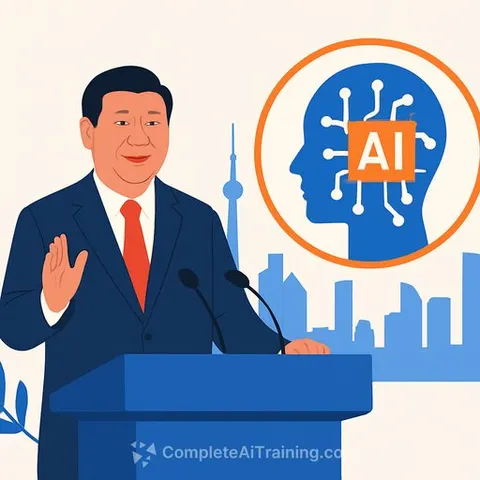
Chinese President Xi Jinping will attend the World Artificial Intelligence Conference (WAIC) in Shanghai for the first time on Friday, where he is expected to outline a vision for global AI governance. Huawei will simultaneously debut its Atlas 950 SuperPoD, a large-scale AI computing cluster built entirely with domestic chips, signaling Beijing's accelerating drive to build alternatives to U.S. technology.
The July 17-20 forum arrives as Washington and Beijing prepare for their first government-level AI talks under the Trump administration. WAIC has shifted from a technology showcase to a venue where China projects its influence over the rules shaping artificial intelligence worldwide. "Against this backdrop, WAIC has become more than a technology showcase; it is now a geopolitical stage where Beijing seeks to articulate its vision of AI as both a national priority and a diplomatic instrument," said George Chen, chair of digital practice at the Asia Group.
Huawei's computing cluster sidesteps sanctions
The Atlas 950 SuperPoD links thousands of Huawei's Ascend AI processors through high-speed interconnects so they operate as a single system for large-scale training and inference. It is one of the clearest demonstrations yet of China assembling advanced AI computing without Nvidia's most advanced chips. DeepSeek's latest V4 model has already been adapted to run entirely on clusters using Ascend chips. Chinese media reported that chipmakers Biren and MetaX will also release new "supernode" computing clusters at the conference.
Beijing frames open-source AI as a public good
China is expected to promote its open-source AI models as low-cost alternatives that can broaden access to the technology, contrasting them with closed U.S. systems. A People's Daily commentary this week said: "The development of AI must never move toward a technological monopoly that walls itself in, but should always be anchored to the fundamental goal of serving humanity." Xi previously compared AI to an "epoch-making, major technological transformation following the steam engine," and Beijing has tied future growth to diffusing AI throughout its economy and achieving self-sufficiency in frontier technologies.
The forum's emphasis on open-source diplomacy and governance aligns with the growing need for government professionals to track how international AI rules are being shaped. AI Learning Path for Policy Makers provides context for those navigating these shifts.
International attendance and the push for a new AI body
UN Secretary-General Antonio Guterres, Kazakh President Kassym-Jomart Tokayev, and Thai Prime Minister Anutin Charnvirakul will join the conference, along with nine Turing Award and Nobel laureates, including deep learning pioneers Yoshua Bengio and Richard Sutton. Representation from major U.S. tech firms remains limited. China proposed creating a World AI Cooperation Organisation (WAICO) at last year's conference, but no countries have formally announced membership. Progress on WAICO and the Global AI Governance Initiative is expected to be announced during a high-level meeting in Shanghai.
An Asian diplomat told Reuters that China "has been making inroads with Southeast Asian countries in terms of AI capacity-building, and portrays itself as speaking up for developing countries who are being left behind in the AI race."
Other product launches at the forum include AI agent smartphones from ZTE-owned Nubia and AI startup StepFun, according to Chinese media.
Why this matters for government, science and research professionals
China's ability to field a sanctions-circumventing AI computing cluster and its push to institutionalize a global AI governance body directly affect the technology's trajectory. For those in government, the upcoming U.S.-China talks and the open-source versus closed-model debate will shape procurement, regulation, and international collaboration. AI for Government resources can help professionals track how these strategic moves influence policy and technology access. Researchers and scientists should note that Huawei's cluster and the adaptation of models like DeepSeek V4 to domestic hardware signal a growing, independent AI ecosystem that may alter the availability of tools and datasets globally.