Conversational AI doesn't understand users - Intent-First architecture does
Customers don't want a conversation. They want the one right answer, fast. Most RAG deployments (embed → retrieve → LLM) miss that mark in production. They guess the context, flood results, ignore freshness and send people in circles.
That's why support volumes spike after "AI search" launches. Wrong answers delivered with confidence erode trust, inflame callers and drive up costs. The fix isn't a bigger model - it's a better architecture and thoughtful Design.
Why standard RAG fails in support
- The intent gap: "I want to cancel" - is that a service, an order or an appointment? In live data, most "cancel" queries were about orders or appointments, yet RAG routed to service-cancel docs. Same word, different job-to-be-done.
- Context flood: Enterprises have dozens of sources: product, billing, policy, promotions, account data. RAG searches them all. Results look close but miss the task. Users bounce.
- Freshness blindspot: Vector similarity can't tell expired offers from current ones. Outdated promos and discontinued products erode credibility fast.
The Intent-First pattern
Flip the sequence: classify first, then route and retrieve. A lightweight model parses the query for intent and context, then sends it to the right sources - documents, APIs or humans.
- 1. Preprocess the query (normalize, expand contractions).
- 2. Classify with a transformer: primary intent + confidence.
- 3. If confidence < 0.70, ask a clarifying question before searching.
- 4. Extract sub-intent (e.g., ACCOUNT → ORDER_STATUS vs PROFILE; SUPPORT → DEVICE_ISSUE vs NETWORK).
- 5. Map intent to sources (ORDER_STATUS → orders DB + order FAQ; DEVICE_ISSUE → troubleshooting KB + device guides).
- 6. Flag whether personalization is required.
Context-aware retrieval (after intent)
- Source config per sub-intent: what to search, what to skip, freshness limit.
- Personalize when authenticated: e.g., ORDER_STATUS pulls recent orders instantly.
- Apply filters: source, content type, max age, user context.
- Search only the mapped sources, not everything.
- Score and rank with a blended formula:
- Relevance (vector similarity) ~40%
- Recency (freshness) ~20%
- Personalization (user match) ~25%
- Intent-type match ~15%
What this fixes for support teams
- "Cancel" stops defaulting to service-cancel. It routes to orders or appointments when that's the actual goal.
- "Activate my new phone" pulls device activation steps - not billing FAQs or store hours.
- Outdated promos and discontinued items get filtered by freshness rules.
Healthcare-specific safeguards
- Separate clinical, coverage, scheduling, billing and account intents by design.
- Clinical queries always include a disclaimer and route complex cases to humans.
- Map formulary and coverage to the latest sources to prevent stale guidance.
Handle frustration fast
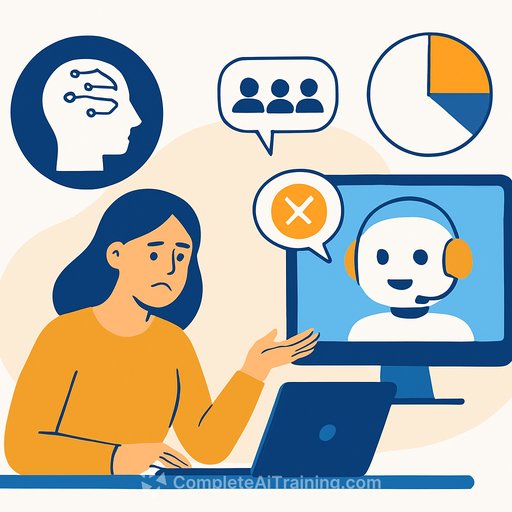
- Detect frustration keywords (e.g., "worst," "still waiting," "speak to human").
- Bypass search and escalate to a human immediately. Don't make angry users repeat themselves.
Implementation checklist
- Define an intent taxonomy with real query logs:
- Telecom: Sales, Support, Billing, Account, Retention
- Healthcare: Clinical, Coverage, Scheduling, Billing, Account
- Finance: Retail, Institutional, Lending, Insurance
- Retail: Product, Orders, Returns, Loyalty
- Map each sub-intent to approved sources and excluded sources.
- Set freshness SLAs per intent (e.g., promos 14 days, clinical docs per publisher cadence).
- Build a lightweight classifier with a confidence threshold and clarifying questions.
- Wire personalization for authenticated sessions (orders, devices, plan, tickets).
- Score results with relevance, recency, personalization and intent-type match.
- Add frustration detection and auto-escalation.
- Instrument metrics: query success rate, escalations, time to resolution, CSAT, return user rate.
Cloud-native notes
- Microservices: intent classification, retrieval, personalization, ranking, analytics.
- Containerize and autoscale the classifier and retrieval services separately.
- Use feature flags for new intents and canary deploys to reduce risk.
- Retrain and reweight weekly based on feedback and drift signals.
Edge cases to plan for
- Low-confidence intents → ask one clarifying question, then route.
- Compliance-sensitive topics → force human review or approved answer sets.
- Seasonal offers → stricter freshness windows and auto-expiry.
Results teams are seeing
- Query success rate: nearly doubled.
- Support escalations: reduced by more than half.
- Time to resolution: down ~70%.
- User satisfaction: up ~50%.
- Return user rate: more than doubled.
First 30 days plan
- Week 1: Audit top 200 intents from chat, search and call transcripts. Tag misroutes and stale answers.
- Week 2: Build the intent map. Assign sources, exclusions and freshness windows.
- Week 3: Ship a classifier MVP for the top 10 intents with a clarifying-question fallback.
- Week 4: Pilot on a narrow scope (e.g., orders + returns). Measure and iterate daily.
Upskill your support org
If you're building or owning AI-assisted support, train the team on intent taxonomies, prompting and evaluation. A curated path helps move faster without guesswork. See the Customer Support paths here: Complete AI Training - Courses by Job.
Bottom line
The demo is easy. Production is hard. Standard RAG retrieves first and hopes for the best. Intent-First figures out what the user actually wants, then searches the right sources with the right rules.
If you want fewer escalations, faster resolutions and happier customers, make intent the first step. The pattern is clear: Intent First.
Your membership also unlocks: