
AI news ·
Zuckerberg deploys AI clone of himself to manage Meta's 79,000 employees
Meta has deployed an AI clone of Mark Zuckerberg to answer questions from its 79,000 employees around the clock. The avatar, built with Synthesia's technology, mimics his voice and decision-making style.
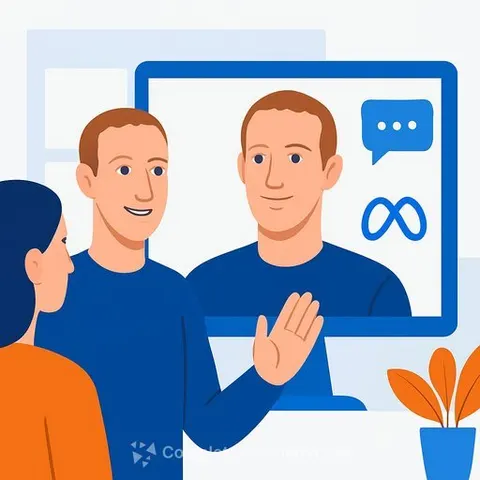
Meta deploys AI clone of Zuckerberg to manage 79,000 employees
Mark Zuckerberg has created a digital version of himself to handle management tasks across Meta's workforce. The AI clone, built using Synthesia's photorealistic avatar technology, mimics his facial expressions, voice, and strategic thinking to field employee questions around the clock.
The system is trained on Zuckerberg's voice recordings, public statements, internal strategic notes, and communication patterns. Any of Meta's 79,000 employees can interact with the replica to get answers without waiting for human intermediaries.
Why Meta is doing this
The company wants to make leadership feel more accessible across time zones and to speed up decision-making. As organizations grow, distance between executives and staff typically increases. Meta frames the clone as a way to keep communication direct and transparent.
The move also fits Meta's broader push to flatten management layers. The company is testing tools like Muse Spark to automate planning and summarize information, reducing friction in daily workflows.
The accountability problem
The experiment raises a straightforward question: who is responsible if an employee acts on guidance from an AI executive and it goes wrong?
Meta will need to establish clear boundaries around what the clone can authorize versus what requires human approval. The company must also document how training data is sourced and updated, and give employees a way to override, escalate, or dispute the AI's guidance.
Without these guardrails, staff face ambiguity about whether they're taking direction from Zuckerberg himself or from a statistical model trained on his past behavior.
What happens next
If the system works, similar approaches could spread across US boardrooms. A hybrid model-where executives work alongside AI versions of themselves-could become standard practice rather than an experiment.
For managers, this raises immediate questions about how AI will reshape your own role. Understanding how to work with AI systems, set boundaries around their authority, and maintain human accountability will matter more as these tools enter decision-making processes. AI for Management resources can help you prepare for these shifts. Those in leadership roles should also consider AI for Executives & Strategy training to understand the governance implications.